
Index Funds vs. Actively Managed Funds

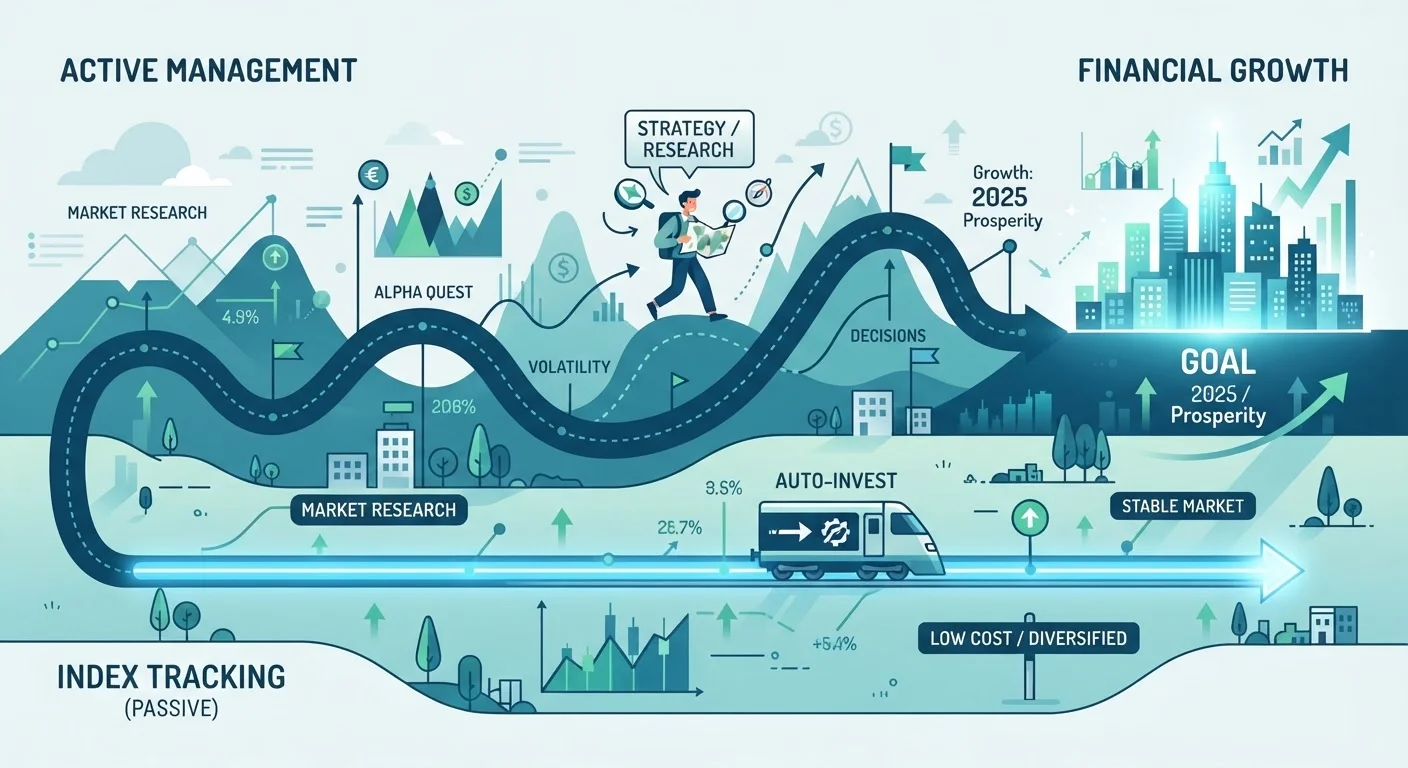
Photo: ShortwebArticles.com | Content For The Curious editorial
Key Takeaways
- Index funds passively track a market benchmark; actively managed funds rely on portfolio managers to pick investments.
- Actively managed funds typically carry significantly higher expense ratios than index funds.
- Research consistently shows most actively managed funds underperform their benchmark index over long periods.
- Neither approach eliminates investment risk — all funds can lose value.
- Your time horizon, fee sensitivity, and risk tolerance should guide which approach fits your situation.
What Sets These Two Approaches Apart
At their core, index funds and actively managed funds answer the same question differently: who — or what — decides what's in your portfolio?
An index fund follows a preset market index, such as the S&P 500 or the total U.S. bond market. The fund automatically holds the same securities as that index in roughly the same proportions. No manager is making judgment calls about which stocks to buy or sell. It is a rules-based, mechanical process designed to mirror market returns.
An actively managed fund puts a portfolio manager — or a team — in charge of those decisions. They research companies, analyze economic trends, and make deliberate bets on which securities will outperform. The goal is to beat the benchmark, not just match it.
If you're new to investing terminology, our beginner's investing glossary explains foundational concepts like expense ratios and benchmarks in plain language.
| Criterion | Index Funds | Actively Managed Funds |
|---|---|---|
| Management style | Passive — tracks an index | Active — manager makes picks |
| Typical expense ratio | 0.03%–0.20% annually | 0.50%–1.00%+ annually |
| Goal | Match benchmark returns | Beat benchmark returns |
| Diversification | Broad, automatic | Varies by manager strategy |
| Long-term performance record | Beats most active funds after fees | Majority underperform benchmark long-term |
| Transparency | High — holdings mirror known index | Lower — manager decisions vary |
| Investor involvement needed | Minimal | Monitor manager performance |
The Cost Gap: Why Fees Matter More Than You Think
The most concrete difference between these two fund types is cost. Index funds typically carry expense ratios (the annual fee taken as a percentage of your investment) well under 0.20%, with many broad market index funds charging 0.03%–0.10%. Actively managed funds commonly charge 0.50%–1.00% or more annually.
That gap sounds small in isolation, but compounded over 20 or 30 years it can represent tens of thousands of dollars on a mid-sized investment portfolio. Every dollar paid in fees is a dollar not compounding on your behalf.
~0.05%
Typical index fund average expense ratio
Morningstar's annual fee study has consistently found the asset-weighted average expense ratio for passive funds to be a fraction of active fund costs.
Over 80%
Active U.S. equity funds underperforming over 15 years
S&P Dow Jones Indices' SPIVA U.S. Scorecard has repeatedly found that more than 80% of active large-cap U.S. equity funds underperformed the S&P 500 over 15-year periods.
1%
Annual fee difference — long-term compounding impact
A 1% annual fee difference on a $50,000 portfolio over 30 years can reduce final value by more than $100,000, assuming consistent average market returns.
This cost structure matters because active managers must not only pick winning investments — they must pick enough winners to overcome their higher fee drag before they can claim genuine outperformance for investors.
What the Performance Record Actually Shows
The historical evidence on active management is sobering. S&P Dow Jones Indices publishes its SPIVA (S&P Indices Versus Active) scorecard regularly, and the findings are consistent: over most 10- and 15-year periods, the majority of actively managed funds in most categories underperform their benchmark index after fees.
This doesn't mean every active fund underperforms — some managers do beat their benchmarks. The challenge is identifying in advance which ones will, and whether that outperformance will persist. Research suggests genuine outperformance is difficult to sustain over multiple market cycles.
Past Outperformance Rarely Persists
For investors thinking about the long game, our article on building good investing habits explores how consistent behavior often matters more than picking the right fund.
Which Approach Fits Your Situation?
Choosing between index and actively managed funds isn't purely about which is objectively superior — it's about what fits your goals, timeline, and comfort level.
Index funds suit investors who want simplicity, low costs, and reliable broad market exposure without monitoring a manager's decisions. They are a natural fit inside retirement accounts where long time horizons amplify the cost advantage.
Actively managed funds may appeal if you believe a specific manager has expertise in a niche area — such as emerging markets or small-cap value stocks — where information is less widely available and active research might genuinely add value. Accepting the higher cost and the risk of underperformance is part of that trade-off.
Many investors hold both — using low-cost index funds as their core position and allocating a smaller portion to active strategies they believe in. This is general educational information; for guidance tailored to your financial situation, consult a qualified, licensed financial adviser.
You can also explore how these fund types compare structurally to other vehicles in our guide to ETFs vs. mutual funds, or start from the beginning with our complete beginner investing guide.
This article is for general informational and educational purposes only and does not constitute personalized financial, investment, tax, or legal advice. Past fund performance does not guarantee future results. Consult a licensed financial professional before making investment decisions.
The content on this site is for informational purposes only and is not a substitute for professional advice. Always consult a qualified professional for guidance specific to your situation.