
Ways People Manage Stress That Tend to Backfire

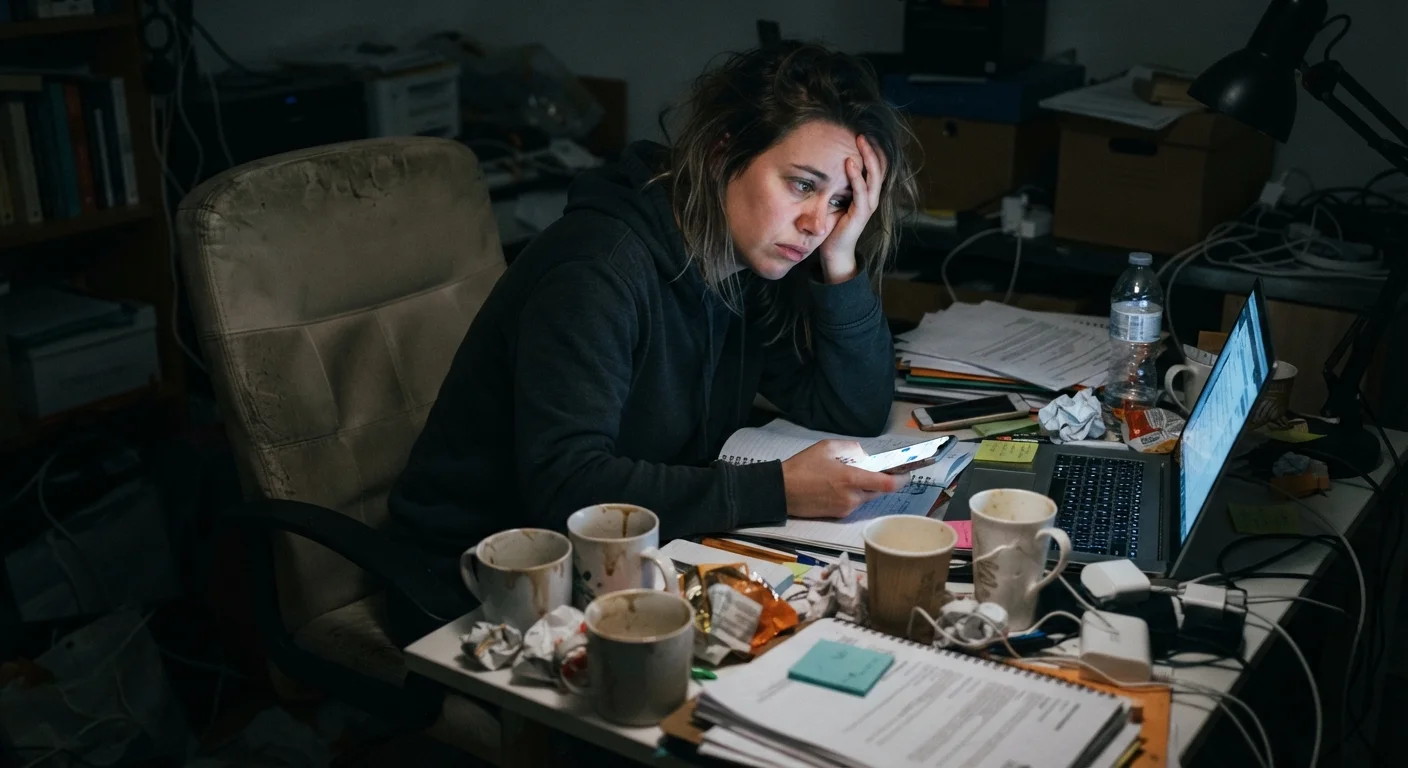
Photo: ShortwebArticles.com | Content For The Curious editorial
Key Takeaways
- Many common stress-relief habits provide short-term relief while reinforcing the underlying problem.
- Venting, avoidance, and retail therapy feel helpful but can amplify anxiety or add new stressors.
- Research-supported alternatives — like reappraisal and structured problem-solving — address stress at the root.
- Recognizing counterproductive patterns is the first step toward replacing them with strategies that actually work.
Why our go-to stress habits so often fail us
Most people have a handful of things they automatically reach for when stress peaks — a vent session with a friend, a glass of wine, an hour of scrolling. These behaviors feel like relief because, in the short term, they often are. The problem is that short-term relief and long-term stress reduction are not the same thing, and some of the most widely used coping strategies actively work against the latter.
This isn't about self-criticism. These habits are understandable, and they're widespread precisely because they do deliver something — a momentary loosening of tension, a sense of control, a distraction from discomfort. But understanding why they tend to backfire is genuinely useful, because it points toward what to do instead. Emotional resilience isn't about white-knuckling through stress — it's about building a toolkit that actually reduces your load rather than just shuffling it around.
This is general information, not medical advice
Six stress habits worth reconsidering
Venting without a plan
Talking about what's wrong feels cathartic, and unburdening yourself to a trusted friend has real social value. The problem arises when venting becomes the entire strategy. Research published in psychological journals has found that repeated, detailed retelling of a stressful event — sometimes called co-rumination — can actually intensify negative emotions rather than discharge them. Going over the same grievance multiple times keeps the nervous system primed rather than settled.
A more useful version of venting includes a clear endpoint: briefly sharing the situation, acknowledging the feeling, then shifting toward what, if anything, can be done. This isn't about toxic positivity — it's about not letting the story loop become the coping mechanism itself.
Repeated retelling of a stressful event can intensify negative emotions rather than discharge them.
Avoiding the source of stress entirely
Avoidance is one of the most instinctive stress responses there is — if something is causing you anxiety, staying away from it delivers immediate relief. But avoidance is also one of the most studied counterproductive coping strategies in behavioral health. When people consistently sidestep stressors (difficult conversations, unopened bills, overdue tasks), those stressors tend to grow, and the avoidance behavior itself becomes self-reinforcing. Over time, the feared situation can feel even more overwhelming.
The alternative isn't to charge headfirst into everything causing you distress. It's to break the avoided task into a manageable first step — one small action that interrupts the avoidance cycle without requiring full resolution all at once. For those whose avoidance has expanded into daily functioning, professional support may be a more appropriate response than self-help strategies alone.
Avoided stressors tend to grow, and the avoidance behavior itself becomes increasingly self-reinforcing.
Retail therapy and impulse spending
Spending money when stressed taps into real psychological mechanisms — novelty, a brief sense of control, and a dopamine response associated with acquiring something new. For many people, it works in the short term. The problem is the aftermath: financial stress compounds emotional stress, and the cycle restarts. Studies on emotional spending consistently show that it provides only transient mood improvement and can add a secondary layer of anxiety in the form of guilt, debt, or buyer's remorse.
If spending is a consistent stress outlet, it's worth examining what underlying need it's serving — novelty, control, reward, or connection — and finding lower-stakes ways to meet that need. Debt and financial pressure often feed back directly into mental health, making spending-based coping a particularly self-defeating loop.
Financial stress compounds emotional stress, turning impulse spending into a self-defeating loop.
Using alcohol or food to decompress
After a hard day, a glass of wine or a plate of comfort food might feel like a well-earned reward. In moderation and in context, neither is inherently harmful. But when either becomes a consistent go-to for stress relief, the pattern warrants attention. Alcohol is a central nervous system depressant — while it can blunt feelings of stress in the short term, it disrupts sleep architecture and can increase baseline anxiety over time. Similarly, using food primarily to soothe emotions can disconnect people from hunger and fullness cues and create its own psychological tension.
This isn't a moral judgment — stress eating and drinking are extremely common and understandable. The concern is habituation: when the brain learns to associate those behaviors with stress relief, it increasingly demands them under pressure. Everyday habits that quietly erode mental health often operate below conscious awareness until the pattern is already entrenched.
Alcohol can blunt stress short-term while increasing baseline anxiety and disrupting sleep over time.
Scrolling or binge-watching as an escape
Passive screen consumption feels restful — it requires nothing of you. But the type of rest it provides isn't the same as actual recovery. Passive scrolling through social media in particular has been linked in multiple studies to increased feelings of inadequacy, anxiety, and disconnection, especially when the content is comparison-heavy. Even ostensibly neutral binge-watching can crowd out sleep, physical movement, and face-to-face interaction — all of which are better supported stress regulators.
Screen use isn't the villain here; context matters enormously. The distinction is between intentional, time-bounded entertainment and reflexive escape that fills every unstructured moment. If boredom or quiet triggers an automatic reach for a device, that automatic quality is the part worth noticing. Understanding why stress feels so physical can help explain why active recovery — movement, sleep, social connection — tends to work better than passive distraction.
Passive scrolling can crowd out sleep, movement, and connection — which are far more effective stress regulators.
Trying to think your way out of it
Logical self-talk — telling yourself a situation isn't really that bad, or that you should calm down — can seem like the rational approach to stress. And in some cases, cognitive reframing genuinely helps. But there's an important difference between reappraisal (genuinely reconsidering the meaning of a stressor) and suppression (telling yourself not to feel what you're already feeling). Suppression, research suggests, tends to increase physiological arousal rather than reduce it.
The more effective version involves acknowledging the feeling first — naming it without judgment — before shifting perspective. Strategies like this are central to many evidence-based therapies. For people who feel stuck in repetitive stress loops despite their best reasoning, understanding how anxiety actually works can help clarify why willpower and logic alone often aren't enough.
Telling yourself not to feel stressed often increases physiological arousal rather than quieting it.
A useful reframe for any coping habit
What actually tends to work
The strategies with the strongest evidence base for stress management share a few things in common: they address the nervous system directly (through movement, sleep, breath, or social connection), they build genuine coping capacity over time rather than providing escape, and they help people develop a slightly more workable relationship with discomfort rather than eliminating it entirely.
None of this means eliminating every imperfect coping habit — it means noticing when a habit is making things harder and having a few alternatives ready. If you're unsure where your current stress patterns fall on that spectrum, mental health professionals are trained specifically to help untangle these patterns. That kind of support is a resource, not a last resort.
This article is for general informational purposes only and does not constitute medical or mental health advice. Please consult a qualified healthcare professional for guidance specific to your situation.
The content on this site is for informational purposes only and is not a substitute for professional advice. Always consult a qualified professional for guidance specific to your situation.