
The Anatomy of a Home Electrical Panel

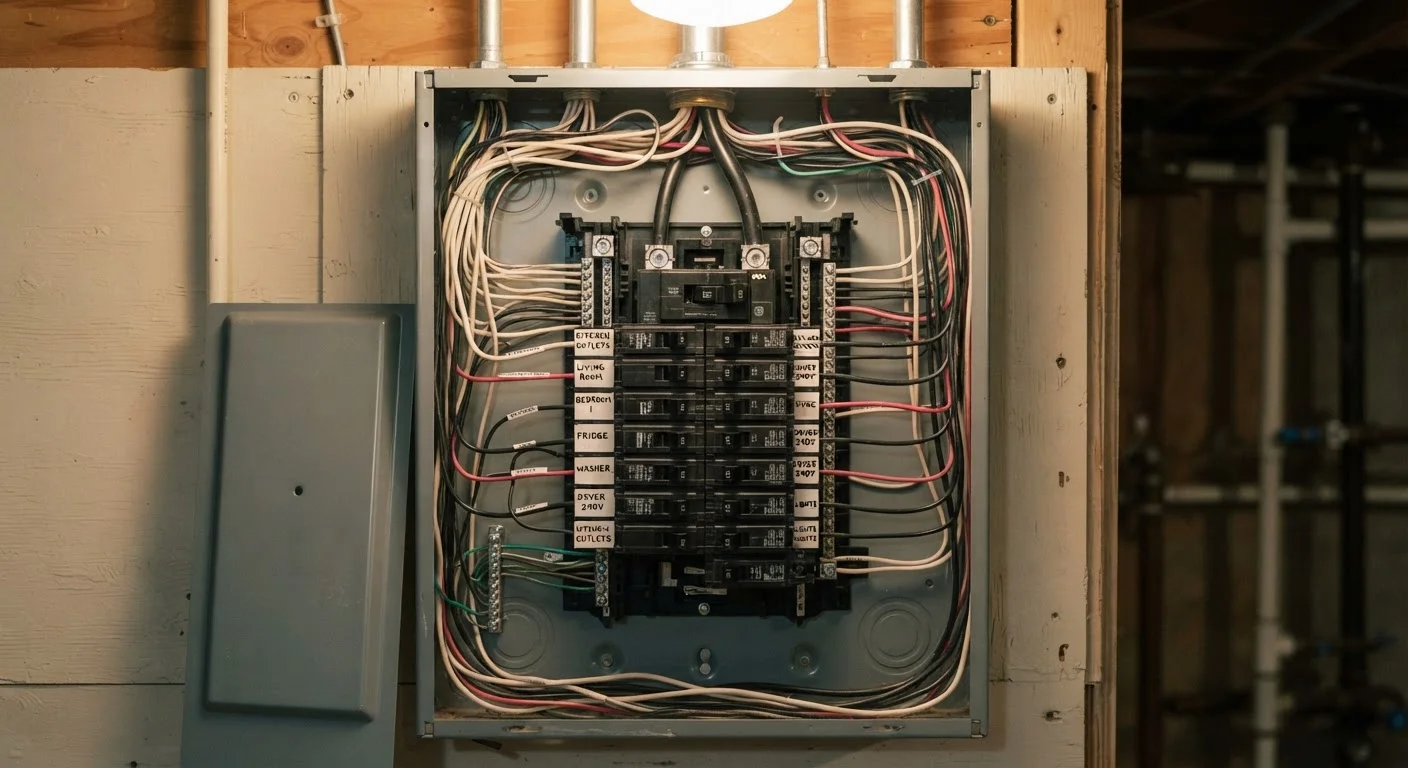
Photo: ShortwebArticles.com | Content For The Curious editorial
Key Takeaways
- Your electrical panel is the distribution hub for all circuits in your home.
- Each circuit breaker protects a single circuit from dangerous overloads.
- The main breaker controls all power entering the panel — it does not cut utility power at the meter.
- Hot wires carry current in; neutral and ground wires provide the return path and safety grounding.
- Panel work beyond resetting a tripped breaker should always be done by a licensed electrician.
Where Utility Power Meets Your Home
Electricity arrives at your home through the service entrance — the point where utility lines connect to your property. Those wires run through your electric meter (which tracks usage) and then directly into the top of your electrical panel. This top portion of the panel, where the service entrance conductors terminate, is always live, even when your main breaker is off. That distinction matters enormously for safety.
From the service entrance, power flows to the main breaker — a large double-pole breaker typically rated at 100, 150, or 200 amps. The main breaker controls all power distributed beyond it inside the panel. It is your first line of defense against whole-home overloads, and it's also the switch to cut power before any downstream panel work — though an electrician will confirm that the service entrance wires above it remain energized regardless.
Your Meter vs. Your Panel
The Core Components Inside the Box
Open any standard breaker panel and you'll see a consistent set of parts working together:
- Hot bus bars: Two metal bars running vertically through the center of the panel. Each carries 120 volts from one leg of the utility's split-phase supply. Individual breakers clip onto these bars to access power.
- Circuit breakers: Each breaker protects one circuit in your home — a bedroom, kitchen outlet group, appliance, or outdoor outlet. Single-pole breakers (one slot) supply 120V circuits; double-pole breakers (two slots) supply 240V circuits for large appliances like dryers and water heaters.
- Neutral bus bar: A long metal strip with screw terminals where the white (neutral) wires from every circuit connect. Neutral wires complete the circuit by carrying current back to the source.
- Ground bus bar: Collects the bare copper or green ground wires from each circuit. In many panels, the neutral and ground bars are bonded together at the main panel only — not at subpanels.
200A
Typical modern home panel capacity
Most newly built American homes are equipped with a 200-amp service panel to handle contemporary electrical loads.
~51%
Home fires with electrical causes
According to the U.S. Fire Administration, electrical malfunctions are among the leading causes of residential structure fires in the United States.
15 or 20A
Standard household circuit ratings
Most general-purpose household circuits are rated for 15 or 20 amps, with higher ratings reserved for large appliances.
How a Circuit Breaker Actually Works
A circuit breaker is both a switch and a protective device. Inside each breaker, a bimetallic strip and an electromagnet monitor current flow. If current exceeds the breaker's rated amperage — say a 15-amp circuit draws 20 amps — the bimetallic strip heats and bends, tripping the breaker handle to a middle "tripped" position. This interrupts the circuit instantly, preventing wire insulation from overheating and potentially starting a fire.
Short circuits — where a hot wire contacts a neutral or ground wire directly — cause an almost instantaneous high-current surge. The electromagnetic mechanism trips the breaker in milliseconds. This is why properly sized breakers are critical: a breaker that's too large for its wiring won't trip at the right threshold, leaving wires vulnerable.
Label Your Breakers Now
Specialized Breakers and Safety Upgrades
Standard breakers have been joined over the decades by two important safety innovations, now required by the NEC in specific locations:
- GFCI Breakers (Ground Fault Circuit Interrupter)
- Detect tiny current imbalances that indicate electricity may be flowing through a person. Required in wet areas like bathrooms, kitchens, garages, and outdoors. These can be installed as breakers in the panel or as GFCI outlets at individual receptacles.
- AFCI Breakers (Arc Fault Circuit Interrupter)
- Detect the electrical arcing that occurs when wires are damaged, loose, or frayed — a leading cause of home electrical fires. The NEC now requires AFCI protection for most living area circuits in new construction and renovations.
If your panel has older technology or lacks these protections in required locations, an electrician can assess whether upgrades are appropriate for your home.
This article is for general informational purposes only. Work inside an electrical panel carries serious risk of electrocution and fire. Always hire a licensed electrician for panel inspection, repair, or upgrades, and verify local permit requirements before any electrical work begins.
Frequently Asked Questions
The content on this site is for informational purposes only and is not a substitute for professional advice. Always consult a qualified professional for guidance specific to your situation.