
Stocks, Bonds, and Cash: Understanding the Core Building Blocks of a Portfolio

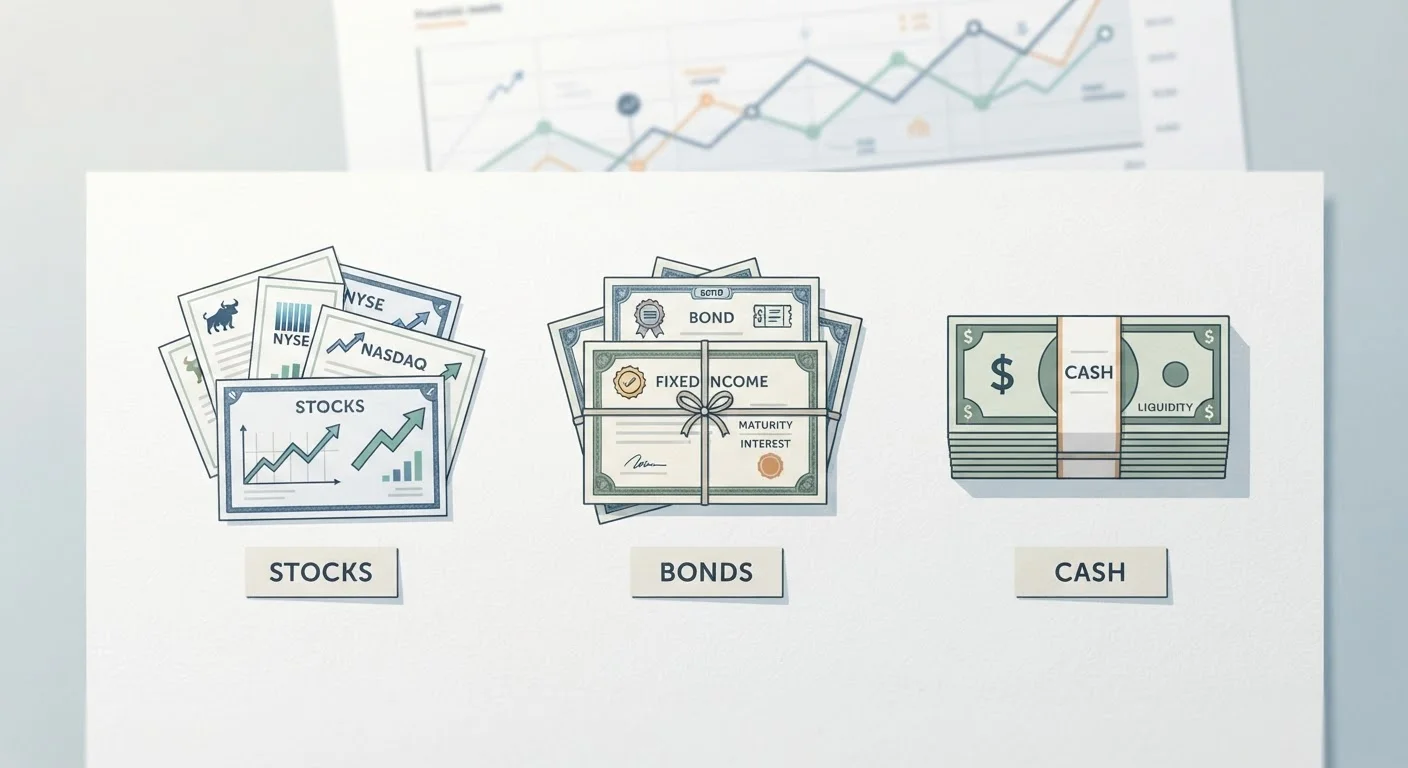
Photo: ShortwebArticles.com | Content For The Curious editorial
Why Asset Classes Matter Before You Invest Anything
Most investing conversations jump straight to specific funds or accounts before covering something more fundamental: what you're actually buying. Stocks, bonds, and cash are the three core asset classes — categories of investments that behave differently from one another across economic conditions. Understanding how each one works gives you a framework for every investment decision that follows.
If you're just getting started, the complete beginner's guide to everyday investing covers the broader landscape before you dig into specific asset types. And for a quick-reference list of key vocabulary, see key terms every beginning investor should know.
| Three Core Asset Classes | Stocks, Bonds, Cash (and equivalents) |
| Stocks: Primary Risk | Market volatility; potential loss of principal |
| Bonds: Primary Risk | Interest rate changes and borrower default |
| Cash Equivalents: Primary Risk | Inflation eroding purchasing power over time |
| Typical Growth Role | Stocks (highest long-term return potential) |
| Typical Stability Role | Bonds and cash (lower volatility) |
Stocks: Ownership With Upside and Downside
When you buy a stock, you're purchasing a small ownership stake — called a share — in a company. If the company grows and becomes more profitable, the value of your shares generally rises. If it struggles, your shares may lose value. There's no guaranteed return, and in the worst case (bankruptcy), stockholders are among the last to recover anything.
Stocks have historically delivered higher long-term returns than the other two asset classes, but they come with meaningfully higher short-term volatility. A portfolio made up entirely of stocks can drop 30–50% during a market downturn — and take years to recover. That's not a scare tactic; it's an honest description of how equity markets behave over time. Risk and return tend to move together.
Stocks are typically the growth engine of a long-term portfolio, making them more appropriate for investors with longer time horizons who can ride out periodic declines without needing to sell.
~10%
U.S. stocks average annual return (historical)
The broad U.S. stock market has historically averaged roughly 10% annual returns before inflation, though individual years vary widely. Past performance does not guarantee future results.
4–5%
Typical long-term U.S. Treasury bond return
Long-term government bonds have historically delivered lower returns than stocks but with less volatility, according to broad historical market data.
Bonds: Lending Your Money for a Predictable Return
A bond is essentially a loan you make to a government or corporation. In exchange, the borrower agrees to pay you a fixed interest rate (called the coupon) over a set period, then return your original investment (the principal) at maturity. Bonds tend to be less volatile than stocks, though they're not risk-free.
Two main risks affect bonds: credit risk (the borrower might default) and interest rate risk (when interest rates rise, existing bond prices fall). U.S. Treasury bonds carry minimal credit risk because they're backed by the federal government, while corporate bonds from financially weaker companies carry significantly more.
Bonds generally serve as a stabilizing force in a portfolio. During periods when stock markets decline sharply, bonds often hold their value better — though this relationship isn't guaranteed and has varied across different market environments. Many investors gradually shift toward a higher bond allocation as they approach retirement and prioritize preserving wealth over growing it.
To see how bonds interact with other investments in a real portfolio, the article on diversification explained without the jargon goes deeper on mixing asset classes.
Asset class
A broad category of investments that share similar characteristics and behave similarly in the market. Stocks, bonds, and cash are the three primary asset classes.
Equity (stock)
A share of ownership in a company. Stockholders may benefit from company growth through price appreciation or dividends, but also bear the risk of loss.
Bond (fixed income)
A debt instrument where the investor lends money to a borrower in exchange for regular interest payments and return of principal at maturity.
Coupon
The fixed interest rate paid to a bondholder, usually expressed as a percentage of the bond's face value, paid on a regular schedule.
Liquidity
How quickly and easily an asset can be converted to cash without significantly affecting its value. Cash is the most liquid asset; real estate is an example of a less liquid one.
Cash equivalents
Short-term, highly liquid investments that can be converted to cash quickly and carry minimal risk of loss. Examples include Treasury bills, money market funds, and short-term CDs.
Cash and Cash Equivalents: Safety, Liquidity, and Opportunity
Cash doesn't just mean dollars in a checking account. In investing, cash equivalents include instruments like money market funds, Treasury bills, and certificates of deposit (CDs) — assets that are highly liquid and carry very low risk of losing value. Their trade-off is that returns are modest, and over long periods, inflation can quietly erode purchasing power.
That said, holding some cash in a portfolio serves real purposes. It provides a buffer for near-term expenses or emergencies, prevents you from being forced to sell stocks or bonds at a bad time, and gives you what investors sometimes call "dry powder" — capital available to deploy when opportunities arise.
How much cash is appropriate depends on your timeline, income stability, and financial goals. Someone with a stable income and a 20-year investment horizon might hold very little. Someone nearing retirement or managing irregular income might keep more. There's no single right answer — which is exactly why consulting a qualified financial adviser can be worthwhile before making significant allocation decisions.
Once you understand how these three building blocks work independently, the next step is learning how to combine them. Index funds vs. actively managed funds and ETFs vs. mutual funds are common vehicles for gaining exposure to stocks and bonds without picking individual securities.
This article is for general informational and educational purposes only. It does not constitute personalized financial, investment, or tax advice. Please consult a qualified financial professional before making investment decisions based on your individual circumstances.
Asset Allocation Is Personal
The content on this site is for informational purposes only and is not a substitute for professional advice. Always consult a qualified professional for guidance specific to your situation.