
The Debt Avalanche and Debt Snowball: What Sets Them Apart

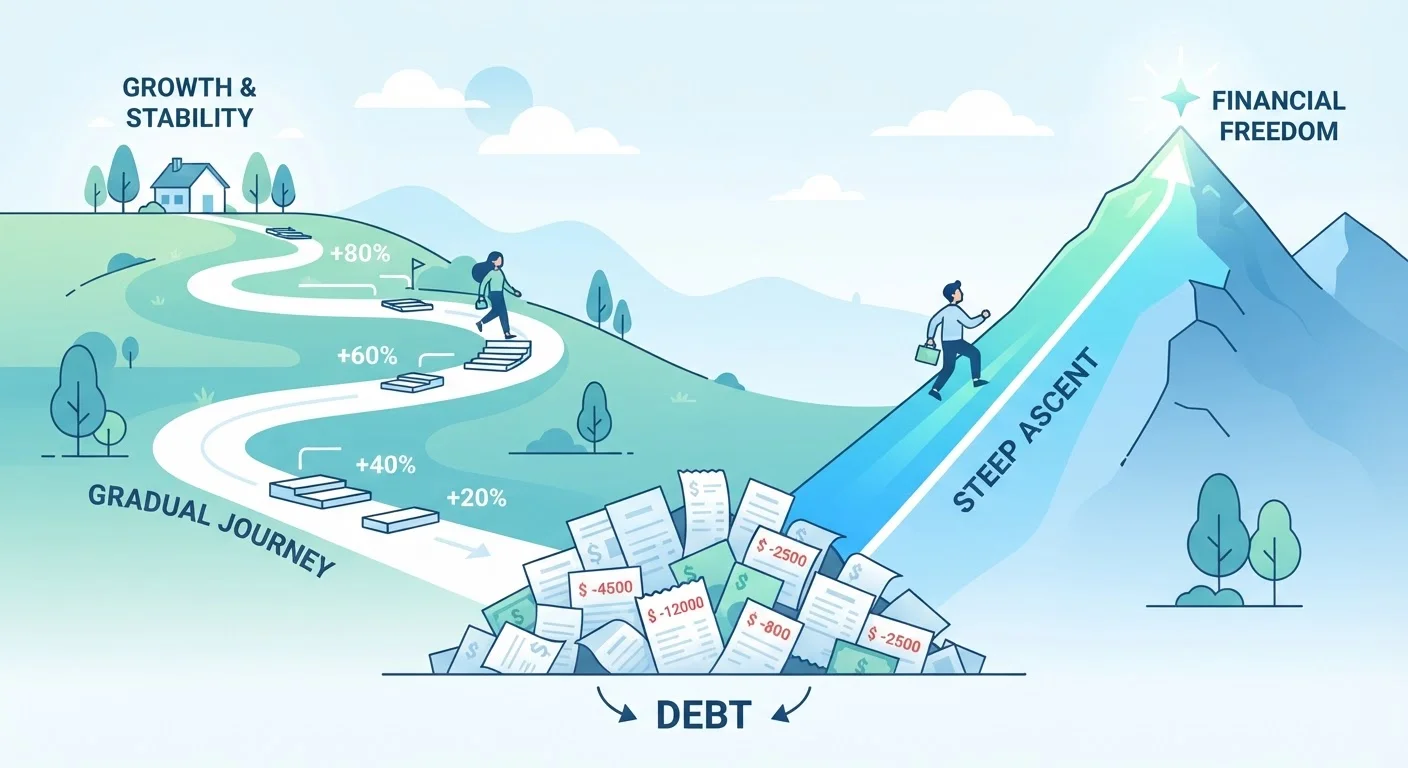
Photo: ShortwebArticles.com | Content For The Curious editorial
Key Takeaways
- The debt avalanche targets high-interest balances first, minimizing total interest paid over time.
- The debt snowball targets the smallest balances first, building motivation through quick wins.
- Neither method requires extra income — both redirect existing minimum payments as debts close.
- Behavioral consistency often matters more than mathematical efficiency in real-world debt payoff.
- Hybrid approaches exist for those who want a balance of savings and psychological momentum.
How Each Method Actually Works
Both the debt avalanche and the debt snowball share the same basic mechanic: you make minimum payments on all your debts, then put any extra money toward one target account at a time. The difference is entirely in how you pick that target.
Debt Avalanche: You rank your debts by interest rate, highest to lowest. You attack the highest-rate balance first, regardless of size. Once it's gone, you roll that payment into the next-highest-rate account, and so on.
Debt Snowball: You rank your debts by balance, smallest to largest. You pay off the smallest balance first. Once cleared, you fold that freed-up payment into the next-smallest balance — creating a growing "snowball" of monthly cash as accounts close.
In both cases, your total monthly payment doesn't change. What changes is where you concentrate the extra force. If you're still weighing how debt payoff fits against building an emergency fund, explore the debt-vs-savings tradeoff before committing to a method.
| Criterion | Debt Avalanche | Debt Snowball |
|---|---|---|
| Payoff order | Highest interest rate first | Smallest balance first |
| Total interest paid | Generally lower | Potentially higher |
| Time to first account closure | Slower (if high-rate debt is large) | Faster |
| Motivational momentum | Builds gradually | Builds quickly |
| Best when... | Rate gaps are wide | Rates are similar or motivation is low |
| Mathematical efficiency | Higher | Lower (but often minor) |
| Psychological appeal | Logic-driven, long view | Win-driven, near-term focus |
The Real Cost Difference
Over a multi-year payoff timeline, the avalanche method generally saves money. Because high-interest debt compounds faster, leaving it open while you clear smaller balances lets it grow — and you pay for that delay.
Consider a simplified example: if you have a $5,000 credit card at 24% APR and a $1,200 medical bill at 0% interest, the snowball would have you clear the medical bill first. The avalanche would rightly ignore it (no interest accruing) and attack the credit card immediately. Over 12–18 months, that sequencing difference can meaningfully affect total interest paid.
~20%
Average credit card APR in the U.S.
The Federal Reserve has reported average credit card interest rates regularly exceeding 20% APR in recent years, making sequencing decisions financially significant.
3–4x
Potential interest cost multiplier on minimum payments
Carrying a balance and paying only minimums can result in repaying several times the original principal over the life of high-interest debt.
That said, the avalanche's advantage shrinks when debts carry similar rates, or when the high-interest balance is small enough to clear quickly under either method. The math favors the avalanche — but only if you actually follow through. Before building your strategy, it's worth reviewing common myths that stall debt payoff progress so you're not working against yourself from the start.
The Psychology Factor: Why Behavior Matters as Much as Math
Behavioral economics research consistently shows that people are more likely to stick with plans that feel rewarding. The snowball method is built on this insight. Closing an account — even a small one — delivers a concrete sense of accomplishment that can reinforce the habit of making extra payments.
The avalanche, by contrast, can feel slow at first. If your highest-rate debt is also your largest balance, months may pass without a single account closing. For some people, that's fine. For others, the lack of visible progress leads to abandonment — which is far more costly than any interest-rate difference between methods.
This isn't a reason to dismiss the avalanche. It's a reason to know yourself. If you've struggled with consistency in the past, the snowball's early wins may be exactly what keeps you going. Once you've chosen an approach, a structured payoff plan can help you put it into action step by step.
A Hybrid Approach Is a Valid Option
Choosing the Right Method for You
There's no universally correct answer. The right method is the one you'll actually maintain for months or years until your balances reach zero. A few questions help narrow it down:
- How wide is the rate gap? If your highest-rate debt carries an APR 10+ points above your others, the avalanche's savings are significant. If rates are bunched closely together, the snowball's motivation advantage may outweigh the minor math difference.
- How do you handle delayed gratification? Honest self-assessment matters here. If you've started and stopped payoff plans before, prioritize the method that gives you feedback sooner.
- How many accounts do you have? With five or more debts, the snowball's rapid early closures can meaningfully simplify your financial picture, reducing mental load alongside balances.
Some people use a hybrid: they clear one or two small balances first for a motivational jump-start, then switch to avalanche order for the rest. This isn't a formal method, but it reflects a practical truth — balancing competing financial goals rarely fits a perfectly rigid framework. And if derailment is a concern, understanding where payoff plans commonly break down can help you build in safeguards before problems arise.
This article is for general informational and educational purposes only and does not constitute personalized financial or legal advice. Consult a licensed financial professional for guidance suited to your individual situation.
The content on this site is for informational purposes only and is not a substitute for professional advice. Always consult a qualified professional for guidance specific to your situation.