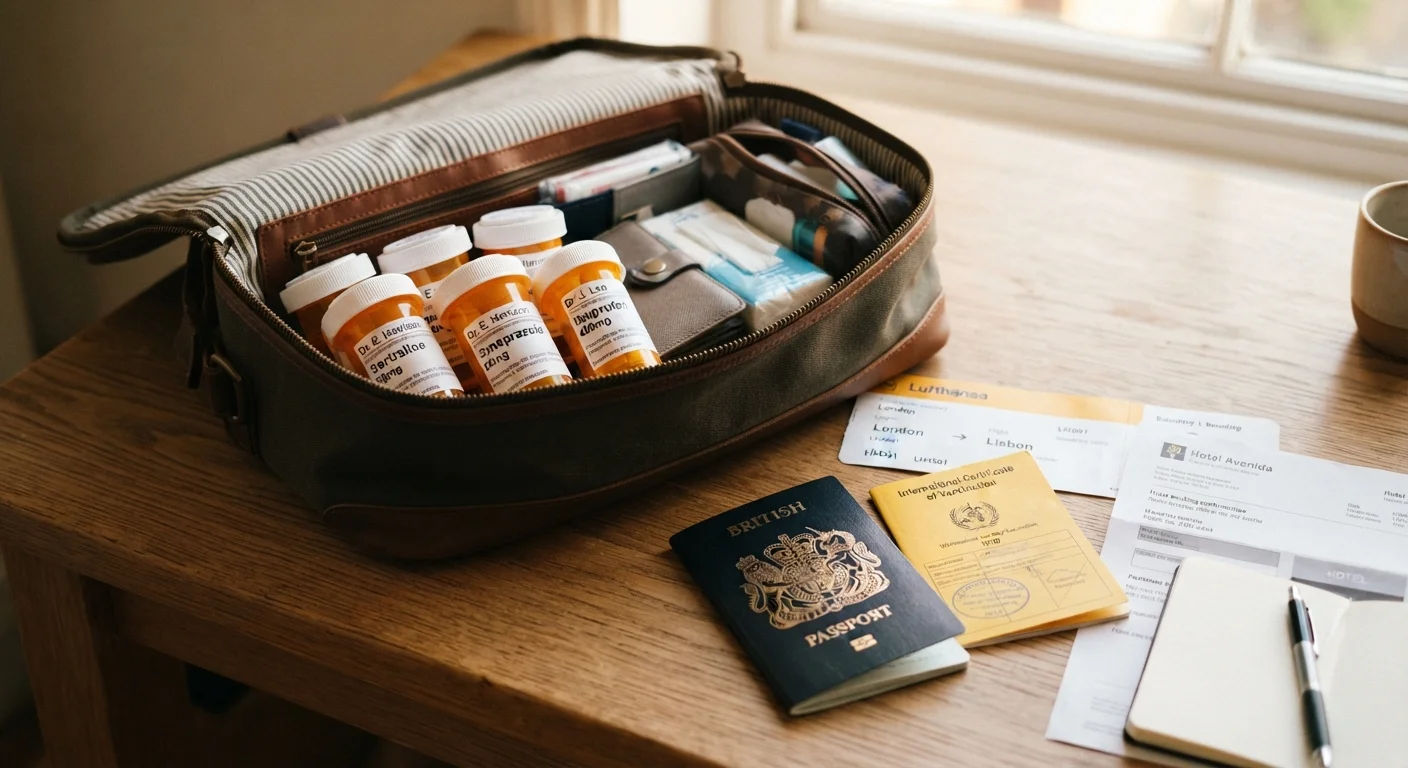
Prescription rules vary significantly by country. What's legal at home may require documentation — or be restricted entirely — abroad.
Why Medication Rules Vary So Much by Country
It's easy to assume that a prescription from your US doctor travels as freely as your passport. It doesn't. Countries set their own drug classifications, and a medication your physician considers routine — certain ADHD stimulants, anxiety medications, or strong pain relievers — may be classified as a controlled substance or even prohibited entirely elsewhere.
Japan, for example, is well known for restricting several common medications including certain decongestants and stimulants. The UAE has strict rules around opioids and some psychiatric medications. Even within the European Union, rules can differ between member states. The variation isn't arbitrary; it reflects each country's own regulatory framework and public health priorities.
The good news: none of this has to derail your trip. It just requires a bit of advance legwork — the same kind of research you'd do for visas or vaccinations. See our practical guide for first-time international travelers for a broader view of what to research before you leave.
Best Practices for Carrying Medications Abroad
Follow these approaches to keep your health routine intact and avoid delays or confiscations at customs.
1
Research your destination's specific medication rules well before departure
Rules differ dramatically between countries, and what's unrestricted in the US may require a permit, a customs declaration, or may be banned entirely abroad. Discovering this at the airport is far too late. Give yourself at least 4–6 weeks of lead time for any required permits.
Example: A traveler heading to Japan checks the Japanese Embassy's official website and discovers their ADHD medication requires advance approval from Japan's Ministry of Health — they apply in time and travel without incident.
2
Keep all medications in their original, pharmacy-labeled containers
Original packaging with the pharmacy label — your name, prescribing doctor, dosage, and drug name — is the clearest proof that a medication is legitimately prescribed to you. Pill organizers can raise questions that original bottles resolve instantly at customs.
Example: A traveler brings three weeks of blood pressure medication in the original bottles; the customs officer in a destination with strict drug controls briefly reviews the labels and waves them through without further questioning.
3
Carry a signed letter from your prescribing physician for every controlled or injectable medication
A physician's letter on official letterhead — stating your diagnosis, the medication name (both brand and generic), dosage, and duration of treatment — can be the difference between smooth entry and a lengthy customs hold. This is especially important for injections, controlled substances, and psychiatric medications.
Example: A diabetic traveler carries a doctor's letter confirming their insulin dependency alongside their supplies; border officials in multiple countries accept the letter as sufficient documentation without further questioning.
4
Bring enough supply for your entire trip plus a reasonable buffer
Obtaining a refill abroad is rarely simple — your US prescription is typically not honored at foreign pharmacies, and an equivalent drug may not be available or may have a different formulation. Delays, extensions, or lost luggage can leave you short.
Example: A traveler on a 10-day trip packs a 14-day supply; when a flight delay extends their trip by two days, they have medication to spare and avoid a stressful scramble.
5
Check whether advance permits or import certificates are required
Several countries — including some in the Middle East, Southeast Asia, and parts of Europe — require travelers to obtain a permit before arriving with certain controlled substances. These applications can take weeks and must come from an official source in the destination country.
Example: A traveler heading to the UAE for a conference contacts the UAE embassy months before departure, secures the required documentation for their prescribed opioid pain medication, and crosses customs without any issue.
6
Verify information only through official government sources
Travel forums and general websites often contain outdated or inaccurate medication rules. Regulations change, and acting on bad information can lead to confiscation or legal trouble. The destination country's embassy in the US and its official health or customs ministry websites are the authoritative sources.
Example: Rather than relying on a years-old forum post, a traveler emails the destination country's US embassy directly and receives current, country-specific guidance in writing before packing.
For a comprehensive pre-departure health review, our international travel health prep guide walks through vaccinations, documentation, and other health considerations by destination type.
Quick Steps You Can Take Before Your Next Trip
high
Pull up the official website of your destination country's embassy in the US and search specifically for medication or controlled substance import rules — do this today, not the week before you fly.
high
Call your prescribing doctor's office and request a signed, dated physician's letter for every controlled or injectable medication you plan to travel with.
medium
Check that all your medications are in original pharmacy-labeled bottles — repack anything that's been moved to a pill organizer before you travel.
medium
Calculate the number of days you'll be away and confirm you have at least that many days' supply plus a few extra doses as a buffer for delays.
high
If your medication is injectable or a controlled substance, ask your doctor or pharmacist whether the destination country requires an advance import permit — then start the application process immediately.
Medication preparation fits naturally into your broader pre-departure checklist. The Before-You-Board Checklist covers documents, health prep, and logistics so nothing slips through the cracks.
This article provides general travel information only and is not medical or legal advice. Medication regulations vary by country and change over time. Always verify requirements with the official embassy or health authority of your destination country and consult your prescribing physician before traveling with any prescription medication.
The content on this site is for informational purposes only and is not a substitute for professional advice. Always consult a qualified professional for guidance specific to your situation.