
What the Lines on American Roads Actually Mean

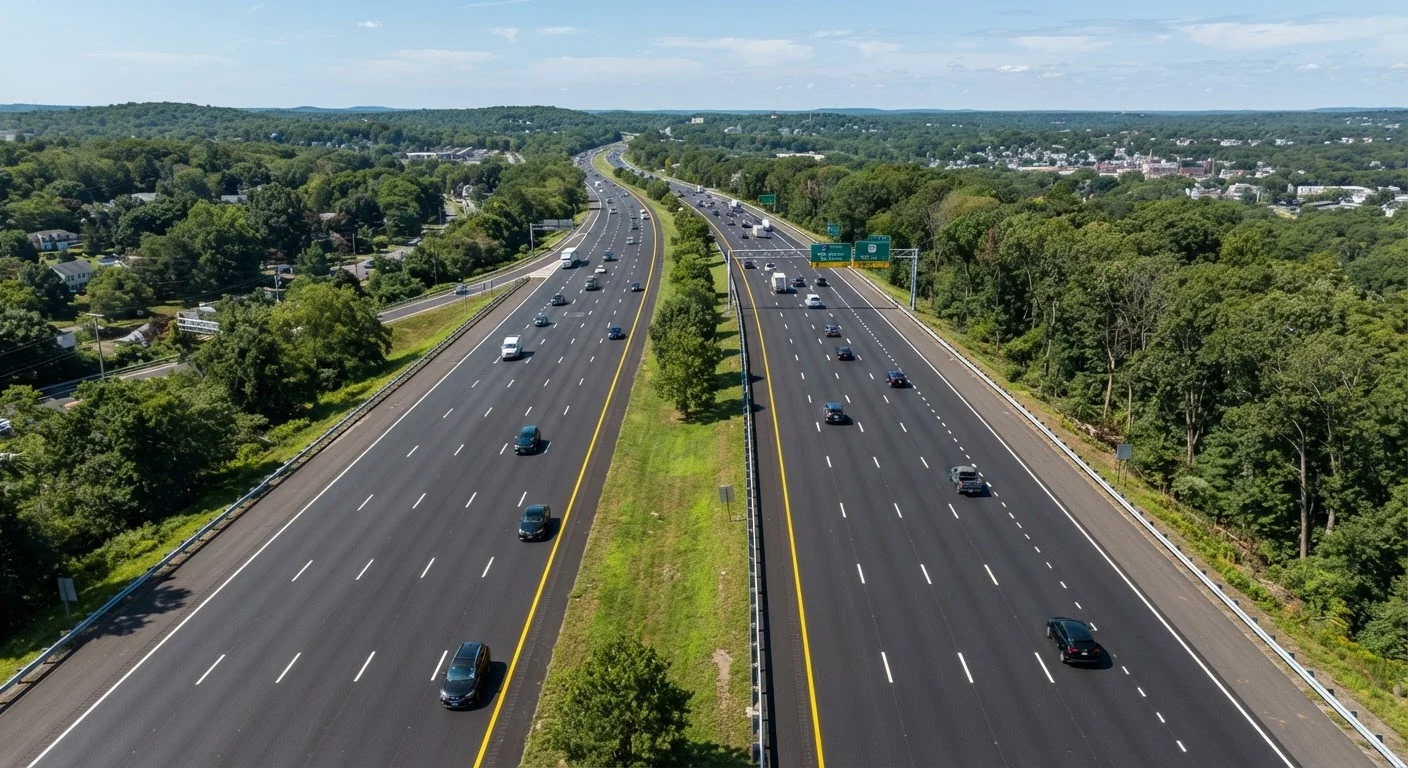
Photo: ShortwebArticles.com | Content For The Curious editorial
The Color Code: Yellow vs. White
Before diving into individual line patterns, it helps to understand the fundamental color split. In the United States, yellow lines separate traffic moving in opposite directions, while white lines separate traffic moving in the same direction or mark the road's edges.
That single rule resolves most confusion on the fly. If you see yellow, you're looking at a boundary between you and oncoming traffic. If you see white, it's organizing lanes that share your direction of travel — or telling you where the pavement ends.
| Governing standard | Manual on Uniform Traffic Control Devices (MUTCD) (Federal Highway Administration) |
| Yellow lines separate | Traffic traveling in opposite directions |
| White lines separate | Traffic traveling in the same direction, or mark road edges |
| Standard broken-line dash length | 10 feet of paint, 30-foot gap (MUTCD standard) |
| Construction zone marking color | Orange (temporary, takes precedence over white when in conflict) |
Yellow Line Markings and What They Permit
Broken yellow center line: Passing is permitted when the broken line is on your side. You may cross it to pass a slower vehicle if sight distance is clear and it's safe to do so.
Solid yellow line on your side: No passing. A solid line on your side of the road means the sight distance or road geometry ahead makes passing unsafe — stay in your lane.
Double solid yellow lines: No passing from either direction. This is one of the most misunderstood markings; it isn't just a suggestion. Crossing double solids is illegal in virtually every state except in very narrow circumstances, such as turning into a driveway.
Broken yellow next to solid yellow: Passing is allowed only from the side with the broken line. The driver facing the solid line must not pass.
Center line
A yellow marking that divides traffic moving in opposite directions. It may be solid, broken, or a combination of both, each indicating different passing rules.
Edge line
A solid white line running along the right edge of the travel lane. It marks the boundary between the driving surface and the shoulder or roadside.
HOV lane
High-Occupancy Vehicle lane, reserved for vehicles carrying a minimum number of occupants (typically two or more). Designated by diamond symbols and posted signs.
Pavement marking
Any line, symbol, or word painted or otherwise applied to the road surface to guide or regulate traffic. Colors and patterns are standardized by the Manual on Uniform Traffic Control Devices (MUTCD).
MUTCD
The Manual on Uniform Traffic Control Devices, published by the Federal Highway Administration. It establishes the national standards for all road signs, signals, and pavement markings in the U.S.
White Line Markings and What They Mean
Broken white lines: The standard lane divider on multi-lane roads. You may change lanes when it's safe. The dashes are 10 feet long with 30-foot gaps — if they look short, you may be traveling faster than you think.
Solid white lines between lanes: Lane changes are discouraged or prohibited. You'll see these near intersections, at on-ramps, and approaching toll plazas. A solid white line doesn't carry the same absolute prohibition as a solid yellow, but crossing one where posted is typically illegal and nearly always unwise.
Solid white edge lines (fog lines): Mark the right edge of the travel lane. Especially useful in low visibility, they tell you exactly where the pavement's safe travel area ends. On divided highways, a solid white line also marks the left edge of the shoulder.
Wide solid white stop lines: Found at intersections and crosswalks, these tell you exactly where to stop. Stopping past this line can block crosswalks or intrude into an intersection — both of which carry fines in most states.
For a broader look at signs and markings that drivers regularly misinterpret, see Speed Limits Americans Misread Most Often.
~40%
Of U.S. crashes involve lane-departure
Lane-departure crashes — where a vehicle crosses a lane line unintentionally — account for a large share of serious road fatalities, according to NHTSA research.
10 ft
Length of a standard broken-lane dash
The MUTCD sets broken white lane lines at 10 feet of paint followed by a 30-foot gap — a proportion designed to look roughly equal at highway speeds.
Special Markings Worth Knowing
Reversible lane arrows: Overhead signals or painted arrows indicate which direction traffic flows in a given lane — this can change by time of day. Never assume; look up at the overhead signal before entering.
HOV (carpool) lane markings: A diamond symbol painted in the lane, plus posted signs, designates a High-Occupancy Vehicle lane. Requirements vary by state but typically require two or more occupants.
Bicycle lane markings: A solid white line with a bike-and-rider symbol reserves space for cyclists. Drivers may cross briefly to access a driveway but should not travel in this lane.
Construction zone markings: Temporary orange paint or raised pavement markers replace permanent markings in active work zones. When orange and white markings conflict, follow the orange. See also Construction Zone Driving: What the Signs and Flaggers Are Telling You for how temporary signals work in those areas.
Planning a long drive? Understanding road markings is just one part of navigating confidently. US Road Trips has guides for driving routes across the country.
State Laws Can Add Detail
The content on this site is for informational purposes only and is not a substitute for professional advice. Always consult a qualified professional for guidance specific to your situation.