
Construction Zone Driving: What the Signs and Flaggers Are Telling You

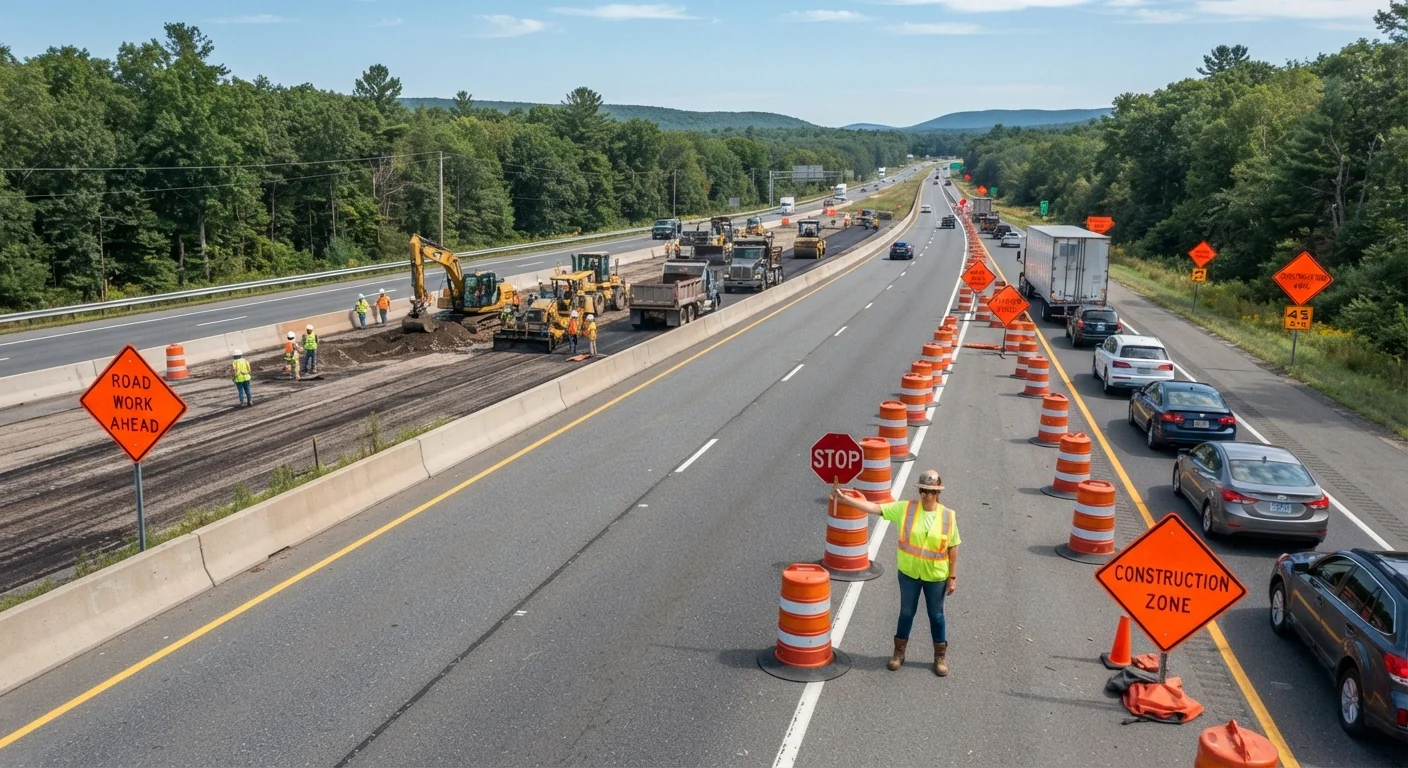
Photo: ShortwebArticles.com | Content For The Curious editorial
How a Work Zone Is Structured
A construction zone isn't a single event — it's a sequence of four distinct areas you pass through in order. Knowing the layout helps you anticipate what's coming instead of reacting to surprises.
- Advance Warning Area: Begins with the first orange sign alerting you to the work zone ahead. On a rural highway, these signs can start 1,500 feet out. On a city street, much closer. Start reducing speed here.
- Transition Zone: Where normal lanes narrow, shift, or merge. Channelizing devices — cones, drums, or barricades — create the taper. Merge early; late merging causes the rear-end crashes that dominate work zone statistics.
- Activity Area: The active work site itself. Workers, equipment, and flaggers are present. Maintain the posted work zone speed and keep focus on the travel lane, not the construction activity.
- Termination Area: Marked by an END ROAD WORK sign or a similar indicator. Traffic returns to normal, but don't accelerate until you're clear of all channelizing devices.
For a broader look at how road markings guide you through lane transitions, see what the lines on American roads actually mean.
| Annual work zone fatalities (U.S.) | Approximately 800–900 per year (Federal Highway Administration (FHWA) data, recent years) |
| Who most often dies in work zones | Drivers and passengers (not workers) in most years (FHWA Work Zone Safety data) |
| Common fine multiplier for speeding in work zones | 2× the standard fine in many states (Varies by state law) |
| Flagger paddle signal: STOP side | Red octagonal face — come to a full stop (MUTCD Part 6) |
| Flagger paddle signal: SLOW side | Orange diamond face — proceed with caution (MUTCD Part 6) |
| Typical advance warning distance (rural highway) | Up to 1,500 feet before the zone (MUTCD recommended distances) |
Reading Work Zone Signs
Work zone signs follow the MUTCD standard and use orange backgrounds with black lettering or symbols. This color combination appears nowhere else in routine traffic control — orange always means temporary conditions ahead.
Common Sign Types
- Warning signs (diamond-shaped, orange): "ROAD WORK AHEAD," "WORKERS PRESENT," "LANE ENDS MERGE LEFT." These appear in the advance warning area and tell you what's coming.
- Regulatory signs (rectangular, white with black text — or orange in some jurisdictions): Posted speed limits within the zone. These are fully enforceable and often carry doubled fines. Many states maintain the enhanced penalty even when no workers are physically on-site. See speed limits Americans misread most often for context on how posted limits work.
- Guide signs: Detour arrows, temporary route markers, and exit guidance when normal routes are closed. Follow them even if they seem indirect — skipping a detour and driving through a closed zone is illegal and dangerous.
Temporary pavement markings — often yellow on top of old white lines — override the original markings. When you see yellow temporary lines, follow those, not the ones underneath them. Understanding standard road line rules makes this distinction easier to apply in real time.
Transition Zone
The section of a work zone where traffic is shifted from its normal path — usually via tapers of cones or drums. Drivers should merge smoothly and early, not at the last moment.
Flagger
A trained worker who directs traffic through a work zone using a STOP/SLOW paddle or, in some situations, a flag. Their instructions carry the same legal authority as a posted traffic signal.
Work Zone Speed Limit
A reduced, legally enforceable speed limit posted specifically for a construction area. Many states double fines for speeding violations within work zones.
Channelizing Device
Any physical barrier used to guide traffic, including cones, drums, barricades, and tubular markers. These define the active travel lane through the zone.
Temporary Traffic Control (TTC)
The overall system of signs, signals, markings, and flaggers installed to manage traffic safely through a work zone. Governed by the MUTCD (Manual on Uniform Traffic Control Devices).
MUTCD
The Manual on Uniform Traffic Control Devices — the federal standard that defines how all traffic signs, signals, and work zone controls must be designed and placed across the U.S.
What Flaggers Are Communicating
Flaggers use a standardized STOP/SLOW paddle — required by the MUTCD in nearly all situations. The paddle has two faces:
- STOP (red octagonal face): Come to a complete stop and stay stopped. Do not creep forward. Do not proceed until the flagger turns the paddle or waves you through.
- SLOW (orange diamond face): Reduce speed and proceed through the zone with caution. Watch for the flagger's free hand or arm — a raised palm means slow further; a waving motion means proceed.
In rare situations where a paddle isn't available, a red flag may be used. The signals mirror the paddle: flag held horizontally across the lane means stop; flag moved up and down means slow.
Flagger Authority Is the Same as a Traffic Signal
Practical tips when approaching a flagger: turn off your radio, roll down your window if needed to hear instructions, and stop at a safe distance — not inches from the flagger. Look at the flagger directly, not at the construction activity. If traffic is moving in both directions through a single lane, wait for the flagger to confirm your turn before entering.
Work zone navigation shares decision-making principles with other complex traffic situations. Scanning ahead and covering the brake are habits that transfer directly to work zones.
Driver Habits That Prevent Work Zone Crashes
The most common work zone crashes — rear-end collisions — are nearly always preventable. Traffic slows or stops unexpectedly in a zone, and drivers following too closely have no time to respond.
Key Adjustments to Make
- Increase your following distance to at least four seconds in a work zone, more at higher speeds. The vehicle ahead may stop with little warning.
- Put the phone away entirely. Distracted driving is a factor in a disproportionate share of work zone incidents. No message is worth the risk to workers or other drivers.
- Match the posted work zone speed — not the speed of surrounding traffic. If other drivers are speeding through a zone, you are not legally or safely obligated to keep pace.
- Be patient with lane closures. Zipper merging — where both lanes flow to the merge point before taking turns — is increasingly being promoted as the most efficient and safe approach. Don't block drivers attempting to use the open lane.
Work zone driving is in some ways the intersection of city and highway driving demands — it requires the low-speed awareness of urban driving and the sustained attention of highway travel.
This article is for general informational purposes. Traffic laws, fine structures, and work zone regulations vary by state. Always follow posted signs and official directions from traffic control personnel in any active work zone.
The content on this site is for informational purposes only and is not a substitute for professional advice. Always consult a qualified professional for guidance specific to your situation.