
Tracking Spending by Hand vs. Using an App

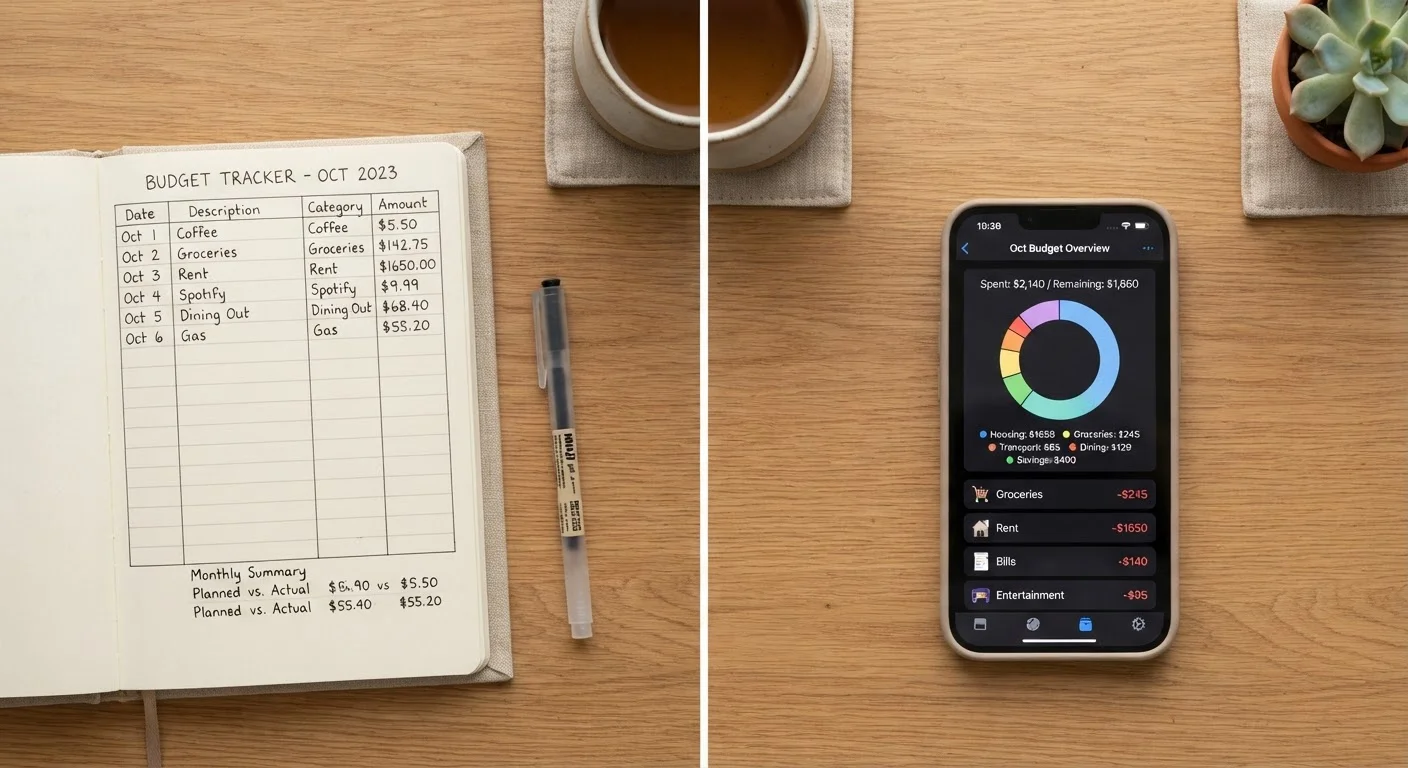
Photo: ShortwebArticles.com | Content For The Curious editorial
Key Takeaways
- Manual tracking builds stronger spending awareness but requires consistent daily effort.
- Budget apps automate data entry but often require linking sensitive financial accounts.
- Neither method is universally superior — the right choice depends on your habits and privacy comfort.
- Combining both approaches occasionally (e.g., weekly manual review with app data) can reinforce discipline.
- Consistency matters more than the tool — a method you skip isn't helping your finances.
Why the Method You Choose Actually Matters
Tracking spending is the foundation of any working budget. Without it, you're guessing — and most people guess wrong. But how you track matters beyond just accuracy. The method shapes whether you stay engaged, whether you notice patterns, and whether the habit lasts beyond the first month.
This isn't about finding the objectively correct tool. It's about understanding what each approach actually delivers so you can make an honest call about what fits your life. If you're newer to budgeting overall, the fundamentals of personal budgeting are worth reviewing before committing to any tracking system.
Tracking by Hand: The Case for Going Analog
Writing down purchases — whether in a notebook, a printed template, or a basic spreadsheet — forces active engagement every time money leaves your wallet. That friction is the point. Research in behavioral finance consistently supports the idea that the act of recording a transaction manually increases awareness and can reduce impulsive spending.
The practical advantages are real:
- No account linking required. Your financial data stays entirely with you.
- Flexible formatting. You track what matters to you, in categories that actually reflect your life.
- Low or zero cost. A notebook and a pen are the only tools you need.
The trade-off is time and consistency. If you forget to log a few transactions, gaps accumulate quickly. Manual tracking works best for people who are highly motivated, have relatively simple finances, and find the ritual of writing grounding rather than burdensome.
Try a One-Week Manual Audit
Budget Apps: The Case for Going Digital
Apps that sync to your bank accounts can categorize and display your spending automatically, often in real time. For anyone juggling multiple accounts, credit cards, or income sources, that consolidation is genuinely useful — it removes the need to remember every transaction and reduces the chance of missing recurring charges.
Key advantages include:
- Automation. Transactions are imported and categorized without manual input.
- Trend visibility. Most apps surface month-over-month comparisons and visual breakdowns.
- Reminders and alerts. You can set thresholds that flag overspending in a category.
The main concerns are privacy and passive use. Linking a bank account to a third-party app introduces data-sharing risks that vary by provider. And because apps do the work for you, it's easy to check your dashboard without truly absorbing what you're seeing. Automation can support discipline — but it can also replace it.
| Tracking by Hand | Budget App | |
|---|---|---|
| Setup time | Low — pen and paper or a spreadsheet | Medium — account linking and configuration |
| Daily effort required | High — manual entry every transaction | Low — often automatic after setup |
| Spending awareness | High — writing reinforces mindfulness | Variable — easy to glance and ignore |
| Data accuracy | Depends on user diligence | Generally high via bank sync |
| Privacy risk | Minimal — no account linking needed | Higher — third-party data access |
| Cost | Free or near-free | Free tiers available; premium plans vary |
| Best for complex finances | Challenging with many accounts | Well-suited to multiple accounts |
What the Research Suggests About Habit Formation
The science of habit formation points to a clear principle: the method that generates the least resistance is the one most likely to stick. Apps win on friction reduction. Manual tracking wins on psychological engagement. Neither guarantees follow-through.
1 in 3
Americans with no budget at all
According to surveys by the National Foundation for Credit Counseling, roughly a third of U.S. adults do not follow any monthly budget.
~60%
Budgeters who prefer digital tools
Consumer research from various financial literacy organizations consistently finds that a majority of active budgeters use some form of app or digital spreadsheet.
What tends to matter more than the tool is building a consistent review routine. Whether you log transactions nightly by hand or review your app's weekly summary, scheduled check-ins — not passive monitoring — are what reinforce behavioral change. This parallels the discipline that underpins other financial habits, like building consistent investing habits over time.
It's also worth noting that some people eventually combine approaches: using an app for data capture but doing a manual monthly review where they categorize and reflect. This can capture the automation benefit while preserving mindful engagement.
Read the Fine Print on Budget Apps
Making the Call: Questions to Ask Yourself
Before choosing a method, consider these honestly:
- How many accounts and cards do you manage? More complexity generally favors an app.
- How comfortable are you sharing financial data with a third party? Discomfort here is a legitimate reason to go manual.
- Do you have 5–10 minutes daily for logging? If not, manual tracking will likely lapse.
- Have you tried one method before and abandoned it? That's useful data — consider switching approaches rather than forcing a repeat.
If you're also thinking about related automation strategies, it's worth understanding how automating your savings compares in practice — some of the same trade-offs apply.
This article is for general informational and educational purposes only and does not constitute personalized financial advice. For guidance specific to your financial situation, consider consulting a licensed financial professional.
The content on this site is for informational purposes only and is not a substitute for professional advice. Always consult a qualified professional for guidance specific to your situation.