
Automating Your Savings: What Works and What to Watch For

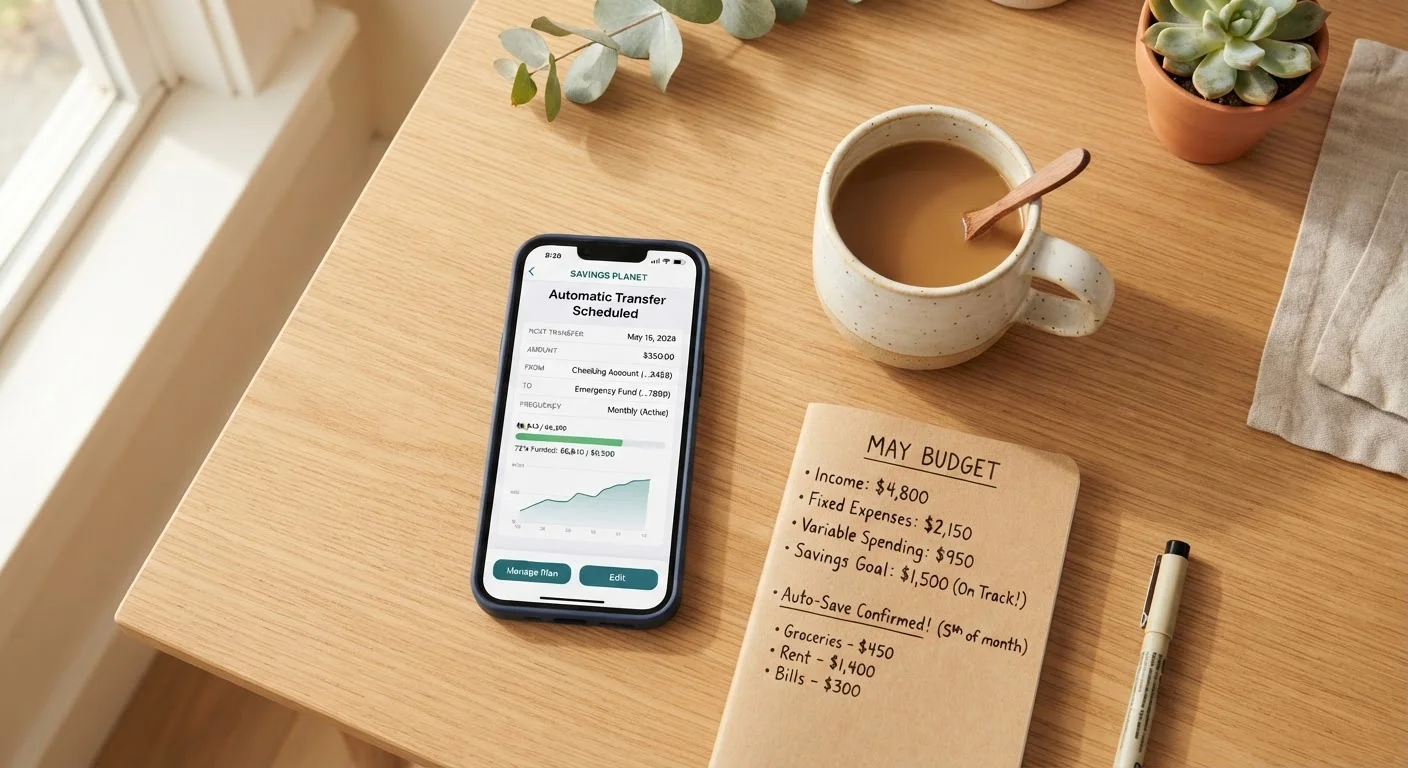
Photo: ShortwebArticles.com | Content For The Curious editorial
Key Takeaways
- Automated savings transfers remove the friction that causes most people to delay or skip saving.
- Set-and-forget systems can cause overdrafts if your cash flow is irregular or unpredictable.
- Automation works best when paired with periodic manual reviews — not as a replacement for them.
- Pairing automation with a high-yield account can amplify long-term results through compound growth.
- Adjust transfer amounts whenever income or expenses change significantly.
Removes willpower from the saving equation
When transfers happen automatically, saving becomes the default rather than a monthly decision. This removes the psychological friction that causes most people to delay or reduce contributions.
Builds a consistent savings habit effortlessly
Regularity matters more than size when building savings. Automated transfers create a reliable cadence that accumulates meaningfully over time, even at modest amounts.
Captures compound growth earlier
Funds deposited sooner have more time to grow. Consistent automated deposits maximize the window for interest or investment returns to compound.
Reduces temptation to spend first
Routing money to savings before it sits in checking shifts the spending default — you work with what remains rather than saving whatever's left at month's end.
Easy to scale up gradually over time
Many systems allow small, incremental increases to your transfer amount, making it straightforward to grow savings as income rises without requiring a major behavioral change.
Can trigger overdrafts with irregular income
Fixed auto-transfers don't adjust for income swings. A slow pay period combined with a scheduled transfer can push a checking account into negative territory, triggering fees.
Encourages a 'set it and forget it' mindset
Automation can create a false sense that savings are handled. Life circumstances change — income, expenses, goals — and a static setup can quietly fall out of step.
Transfer amounts may become outdated
An amount that made sense when you set it up may be too low to meet revised goals or too high after a major expense change. Without review, the gap widens silently.
Doesn't account for high-interest debt priority
Automatically routing money to savings while carrying high-interest debt may cost more in interest than the savings earns — a trade-off that requires deliberate attention, not automation.
Overdraft fees can erode savings gains
If an automated transfer fires on a low-balance day, bank overdraft fees — typically $25–$35 per occurrence — can offset weeks of accumulated savings progress.
How Automated Savings Actually Works
Automated savings means scheduling a recurring transfer from your checking account to a savings account — or directly to a retirement or investment account — without having to initiate it manually each time. You set the amount, the frequency, and the destination once, and the transfer runs in the background.
Most banks and credit unions offer this natively through online banking. Payroll direct deposit can also be split at the source, routing a fixed dollar amount or percentage straight into savings before it ever hits your checking account. Some employers and 401(k) plans support automatic contribution escalation, where your savings rate nudges up by a small percentage each year.
The core appeal is behavioral: when saving happens automatically, you spend what remains rather than saving what's left after spending. That order-of-operations shift is surprisingly powerful. For a deeper look at where to send those automated transfers, see our comparison of high-yield vs. traditional savings accounts.
The Real Advantages
The strongest argument for automation is consistency. Research in behavioral economics consistently shows that people save more when the default is to save — not to decide. Removing the decision removes the temptation to skip a month.
Removes willpower from the saving equation
When transfers happen automatically, saving becomes the default rather than a monthly decision. This removes the psychological friction that causes most people to delay or reduce contributions.
Builds a consistent savings habit effortlessly
Regularity matters more than size when building savings. Automated transfers create a reliable cadence that accumulates meaningfully over time, even at modest amounts.
Captures compound growth earlier
Funds deposited sooner have more time to grow. Consistent automated deposits maximize the window for interest or investment returns to compound.
Reduces temptation to spend first
Routing money to savings before it sits in checking shifts the spending default — you work with what remains rather than saving whatever's left at month's end.
Easy to scale up gradually over time
Many systems allow small, incremental increases to your transfer amount, making it straightforward to grow savings as income rises without requiring a major behavioral change.
Automation also pairs naturally with compound growth. Money deposited earlier — even in small amounts — has more time to generate returns. Our explainer on what compound interest actually does to your money over time shows why timing matters as much as amount.
For people managing both savings and debt, automation makes it easier to fund both goals simultaneously without mentally negotiating between them each month. The complete walkthrough on saving and paying down debt at the same time covers how to structure that balance.
The Drawbacks Worth Taking Seriously
Automation has a meaningful downside: it can feel like a solved problem when it isn't. Once transfers are running, many people stop checking them — which creates its own set of risks.
Can trigger overdrafts with irregular income
Fixed auto-transfers don't adjust for income swings. A slow pay period combined with a scheduled transfer can push a checking account into negative territory, triggering fees.
Encourages a 'set it and forget it' mindset
Automation can create a false sense that savings are handled. Life circumstances change — income, expenses, goals — and a static setup can quietly fall out of step.
Transfer amounts may become outdated
An amount that made sense when you set it up may be too low to meet revised goals or too high after a major expense change. Without review, the gap widens silently.
Doesn't account for high-interest debt priority
Automatically routing money to savings while carrying high-interest debt may cost more in interest than the savings earns — a trade-off that requires deliberate attention, not automation.
Overdraft fees can erode savings gains
If an automated transfer fires on a low-balance day, bank overdraft fees — typically $25–$35 per occurrence — can offset weeks of accumulated savings progress.
Overdraft Protection: A Partial Safety Net
Irregular income — freelance, hourly, seasonal — adds another complication. A fixed auto-transfer that fits a strong month can overdraft an account in a slow one. In that case, variable automation tied to a percentage of deposits rather than a flat dollar amount may be more appropriate, though not all financial institutions offer this feature.
Finally, automation doesn't substitute for a broader financial picture. A periodic financial checkup helps you confirm that your automated setup still reflects your current goals and circumstances.
Making Automation Work for Your Situation
Start conservatively. A transfer amount that's slightly too low is far less damaging than one that repeatedly triggers overdraft fees or pushes you toward credit card debt to cover monthly expenses. You can always increase the amount once you've confirmed the baseline is sustainable.
~36%
Americans with no emergency savings
A Bankrate survey found roughly one in three Americans has no emergency savings at all, underscoring how difficult manual saving is for most households.
3–6 months
Recommended emergency fund target
Financial planners broadly recommend holding three to six months of essential expenses in accessible savings — a goal automation helps reach incrementally.
Timing matters too. Scheduling transfers for the day after your paycheck arrives — rather than mid-cycle — reduces the chance of a shortfall. If your income varies, consider reviewing your cash balance weekly rather than relying entirely on automatic transfers to self-regulate.
Automation also works well alongside manual habits rather than replacing them. Tracking your spending, even briefly each month, keeps you aware of whether your automated system still fits your life. And if budgeting is where you're starting from scratch, the budgeting basics hub offers a grounded foundation to build on.
This article is for general informational purposes only and does not constitute personalized financial advice. For guidance specific to your situation, consult a licensed financial adviser or qualified professional.
The content on this site is for informational purposes only and is not a substitute for professional advice. Always consult a qualified professional for guidance specific to your situation.