
What Compound Interest Actually Does to Your Money Over Time

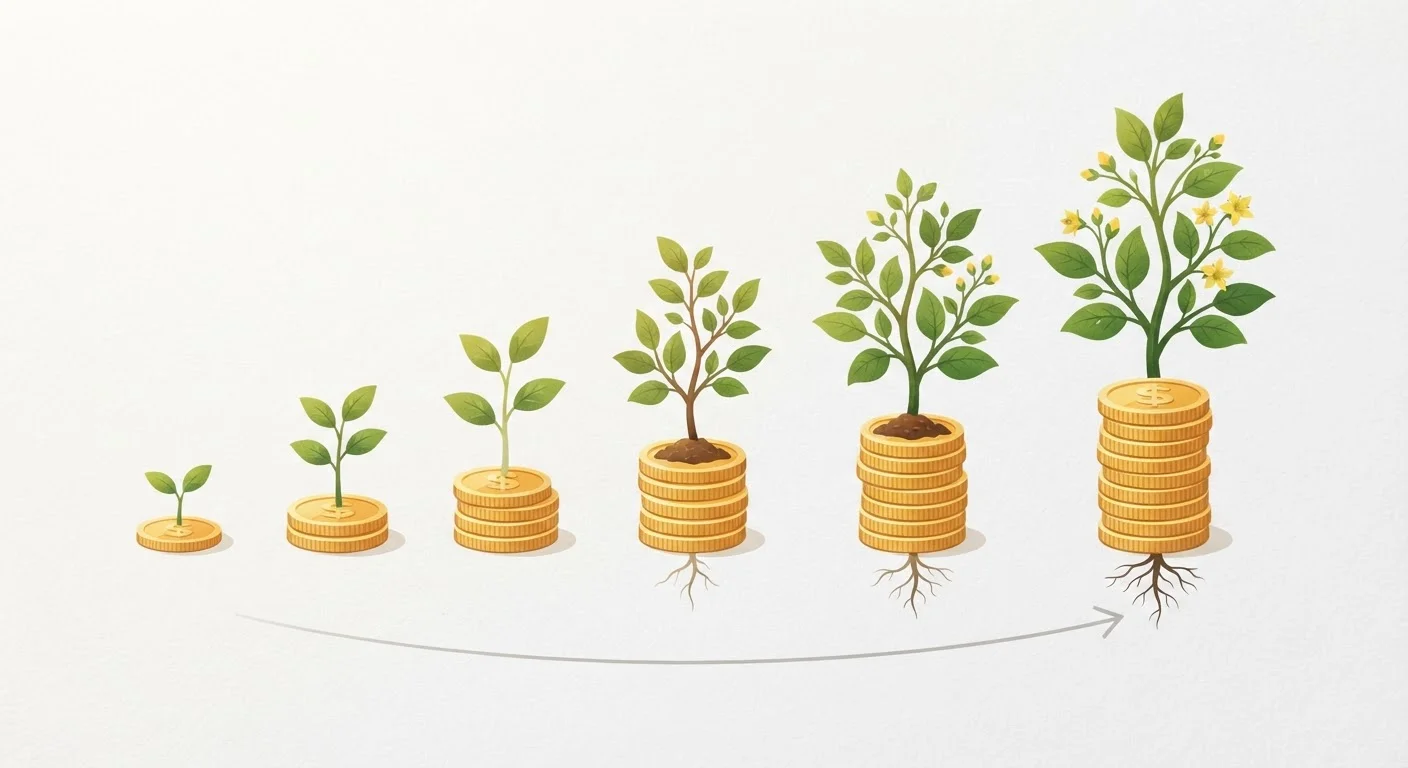
Photo: ShortwebArticles.com | Content For The Curious editorial
Key Takeaways
- Compound interest grows on both your principal and your previously earned interest, creating an accelerating snowball effect.
- Starting even a few years earlier can result in significantly more wealth at retirement than starting later with larger contributions.
- Compounding works against you too — high-interest debt compounds just as relentlessly as savings.
- Contribution consistency and time in the market typically matter more than the size of any single deposit.
- Even modest interest rates produce dramatic results across decades — patience is the primary ingredient.
The Core Mechanic: Why Interest on Interest Changes Everything
Picture a snowball rolling downhill. At the top, it's small. Each rotation picks up a thin layer of snow — not much on its own. But as it grows, each rotation covers more surface area and collects far more snow. That's the physical analogy for compound interest.
Here's a simplified illustration. Suppose you deposit $1,000 at a 5% annual interest rate:
- Year 1: You earn $50 in interest. Balance: $1,050.
- Year 2: You earn 5% on $1,050 — that's $52.50. Balance: $1,102.50.
- Year 10: Balance has grown to roughly $1,629 without any additional deposits.
- Year 30: Balance approaches $4,322 — more than four times your original deposit.
No additional contributions. No market risk. Just time and compounding. The longer the runway, the steeper the curve. For a deeper look at how interest rates affect larger financial commitments, see our piece on how interest rates shape what homes cost you.
Rule of 72
Rough doubling-time estimate at any interest rate
Divide 72 by your annual rate to estimate years to double; at 6%, that's roughly 12 years — a widely used illustration in financial education.
~10x
Approximate growth of $1 over 40 years at 6%
Based on standard compound interest calculations, a single dollar left to compound at 6% annually for 40 years grows to approximately $10.29 without any additional contributions.
10 years
Early investing window that's hard to overcome
Financial educators frequently illustrate that investors who begin a decade earlier can end up with comparable or greater balances despite contributing far fewer total dollars over their lifetime.
Why Starting Early Outweighs Starting Big
This is the counterintuitive truth that catches most people off guard: when you start matters more than how much you start with.
Consider two savers. Person A invests $200 a month starting at age 25 and stops contributing at 35 — just 10 years of deposits, then lets the balance ride. Person B waits until 35 and contributes $200 a month all the way to 65 — a full 30 years of contributions. Assuming the same average annual return, Person A often ends up with a larger or comparable balance at 65, despite contributing for far fewer years. The early decade of compounding creates a lead that's nearly impossible to overcome.
This isn't a pitch for any specific investment product — it's a structural fact about how exponential growth works. The financial terms that underpin every savings conversation can help you get oriented if words like "APY" or "principal" still feel unfamiliar.
Make Compounding Automatic
Compounding Works Both Ways: The Debt Warning
Everything described above flips when you're the borrower. Credit card balances, personal loans with high rates, and payday loans all compound — meaning unpaid interest gets added to your principal, which then generates more interest.
A $3,000 credit card balance at 22% APR, left untouched, doesn't stay at $3,000. It compounds monthly. Within three years without payments, that balance could exceed $5,500. The math is identical to the savings example — it just runs in the wrong direction.
This is why financial educators consistently emphasize paying off high-interest debt before aggressively investing. The guaranteed "return" of eliminating a 20%+ interest rate almost always beats uncertain investment gains. For a structured overview of debt and savings mechanics, the Saving & Debt hub covers the landscape in practical terms.
Putting Compounding to Work in Your Own Finances
You don't need a large lump sum to benefit from compounding — you need consistency and time. A few practical principles worth understanding:
- Reinvest earnings automatically. Dividends or interest paid out and not reinvested break the compounding chain. Most accounts and investment platforms offer automatic reinvestment options.
- Contribute regularly. Adding money consistently — even small amounts — amplifies compounding because each new deposit starts its own compounding clock. Automating your savings is one practical way to stay consistent without relying on willpower.
- Don't interrupt the process. Withdrawing money early resets your compounding base. Leaving funds invested through market cycles — rather than reacting to short-term noise — is central to long-term results.
For those ready to move from understanding to action, building good investing habits from the start explores the behavioral side of making these principles stick.
This article is for general informational purposes only and does not constitute personalized financial or investment advice. Please consult a qualified financial adviser before making decisions about your own money.
Frequently Asked Questions
The content on this site is for informational purposes only and is not a substitute for professional advice. Always consult a qualified professional for guidance specific to your situation.