
Why Paying the Minimum on Credit Cards Keeps You Stuck

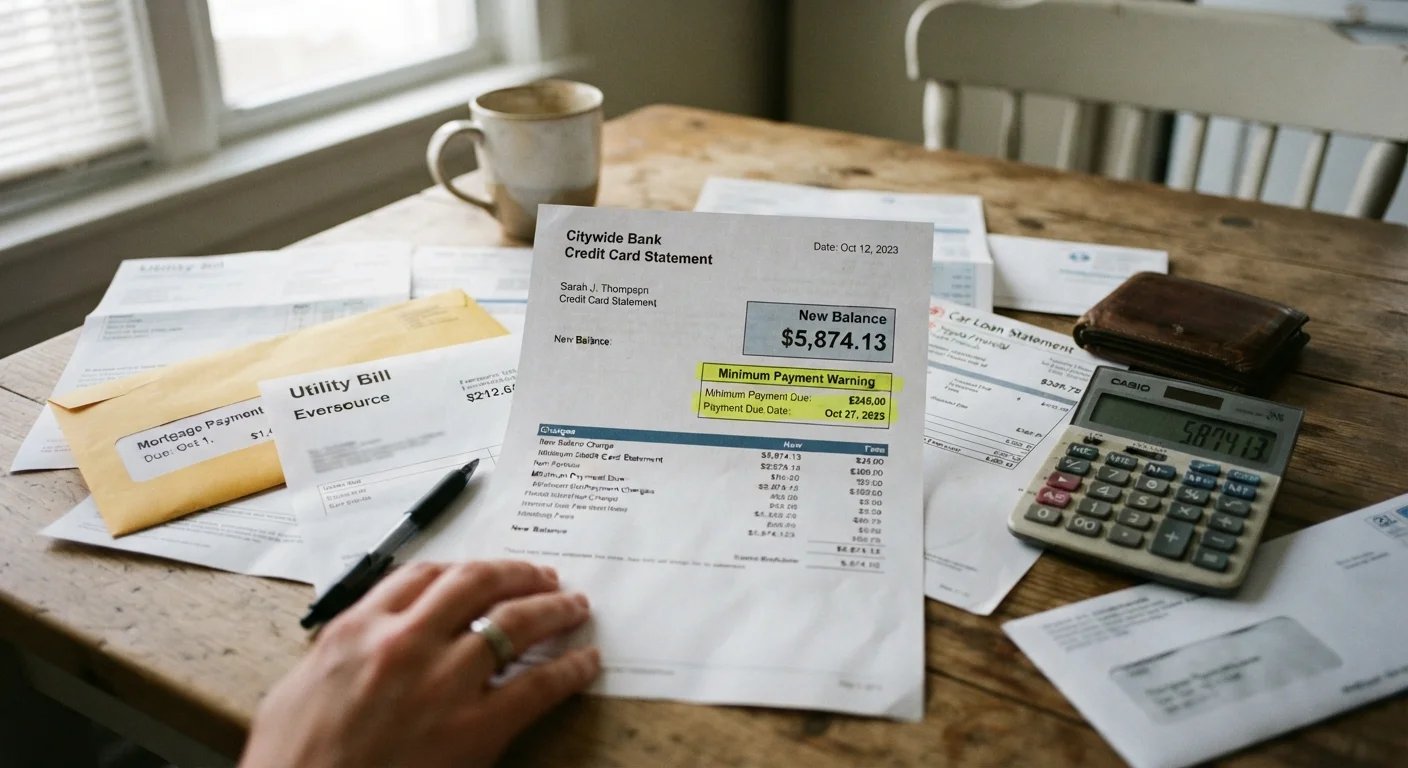
Photo: ShortwebArticles.com | Content For The Curious editorial
Key Takeaways
- Minimum payments are designed to keep you in debt longer, maximizing interest paid to the issuer.
- On a $5,000 balance at 20% APR, paying only the minimum can take over 15 years to pay off.
- The bulk of each minimum payment covers interest, not the actual balance you owe.
- Even modest increases above the minimum can dramatically shorten your payoff timeline.
- Your monthly statement is legally required to show your true payoff timeline — check that number.
How the Math Works Against You
Credit card interest is calculated daily on your remaining balance. When you pay only the minimum, a large portion of that payment is immediately consumed by the interest that accrued during the billing cycle. The remainder — sometimes just a few dollars — chips away at your actual principal balance.
Here's a concrete illustration: on a $5,000 balance at a 20% annual percentage rate (APR), a typical minimum payment might start around $100. Of that, roughly $83 covers interest. Only about $17 reduces what you owe. At that pace, you'd be looking at more than 15 years to pay off the balance — and total interest charges that could exceed the original debt itself.
15+ years
Time to pay off $5,000 at 20% APR on minimums
Calculated using standard amortization on a balance with a minimum payment floor of approximately 2% of balance or $25, whichever is greater.
~$83
Interest portion of a $100 minimum on $5,000 at 20% APR
Illustrative calculation showing how little of a minimum payment actually reduces the principal balance each month.
91%
Share of U.S. adults who have at least one credit card
According to Federal Reserve consumer finance data, credit card use is near-universal among American adults, making minimum-payment habits broadly consequential.
This math is not a coincidence. Minimum payment formulas are set by issuers, and a low floor benefits them by extending the period you carry a balance. Understanding this structure is the first step toward breaking out of it.
Why It Feels Manageable When It Isn't
Minimum payments are psychologically comfortable. The number is small, it fits the budget, and paying it on time feels responsible. The problem is that comfort and progress are two very different things.
When you carry a balance month to month, every new purchase you make also begins accruing interest immediately — there's no grace period on new charges once you're revolving a balance. So your effective cost for everyday spending quietly rises. This is one of several hidden costs of carrying a balance that aren't obvious from the statement alone.
Check Your Statement's Payoff Box
There's also a drift problem. As your balance slowly decreases, so does the minimum payment — which means you're paying even less toward principal over time if you stick to the floor. Some people interpret a shrinking minimum as a sign things are improving, when the opposite is often true in the short term.
The Payoff Timeline Nobody Wants to Read
The CARD Act of 2009 requires credit card issuers to print a payoff disclosure on every statement. It shows two things: how long it takes to pay off your balance making only minimum payments, and what you'd need to pay monthly to be debt-free in three years. Most people skip past it.
Reading that disclosure is genuinely useful. If your statement says it will take 18 years to pay off your current balance at the minimum, that number alone can shift how you approach the next payment. It reframes the minimum not as a safe floor but as a slow drain.
It's worth cross-checking your assumptions about debt, too. Some widely held beliefs about what it takes to pay down debt aren't accurate — see how common debt payoff myths slow people down for a fuller picture.
What to Do Instead
The goal isn't to pay a perfect amount — it's to consistently pay more than the interest charge so the principal drops every month. Even an extra $30 or $50 above the minimum makes a measurable difference over time when it's applied consistently.
If multiple cards are involved, a structured approach matters. The avalanche method targets the highest-interest balance first to minimize total interest paid. The snowball method starts with the smallest balance for psychological momentum. Either can work; what matters is committing to a plan. For a step-by-step approach, building a debt payoff plan from scratch walks through how to organize balances and set a realistic timeline.
If cash flow is genuinely tight, it helps to think about debt payoff and savings together rather than as competing goals. Saving and paying down debt simultaneously is possible with the right structure — you don't have to fully pause one to make progress on the other.
This article is for general informational and educational purposes only and does not constitute personalized financial advice. Consult a qualified financial professional for guidance specific to your situation.
Frequently Asked Questions
The content on this site is for informational purposes only and is not a substitute for professional advice. Always consult a qualified professional for guidance specific to your situation.