
The Nutrition Label Decoded: What Every Number Really Means

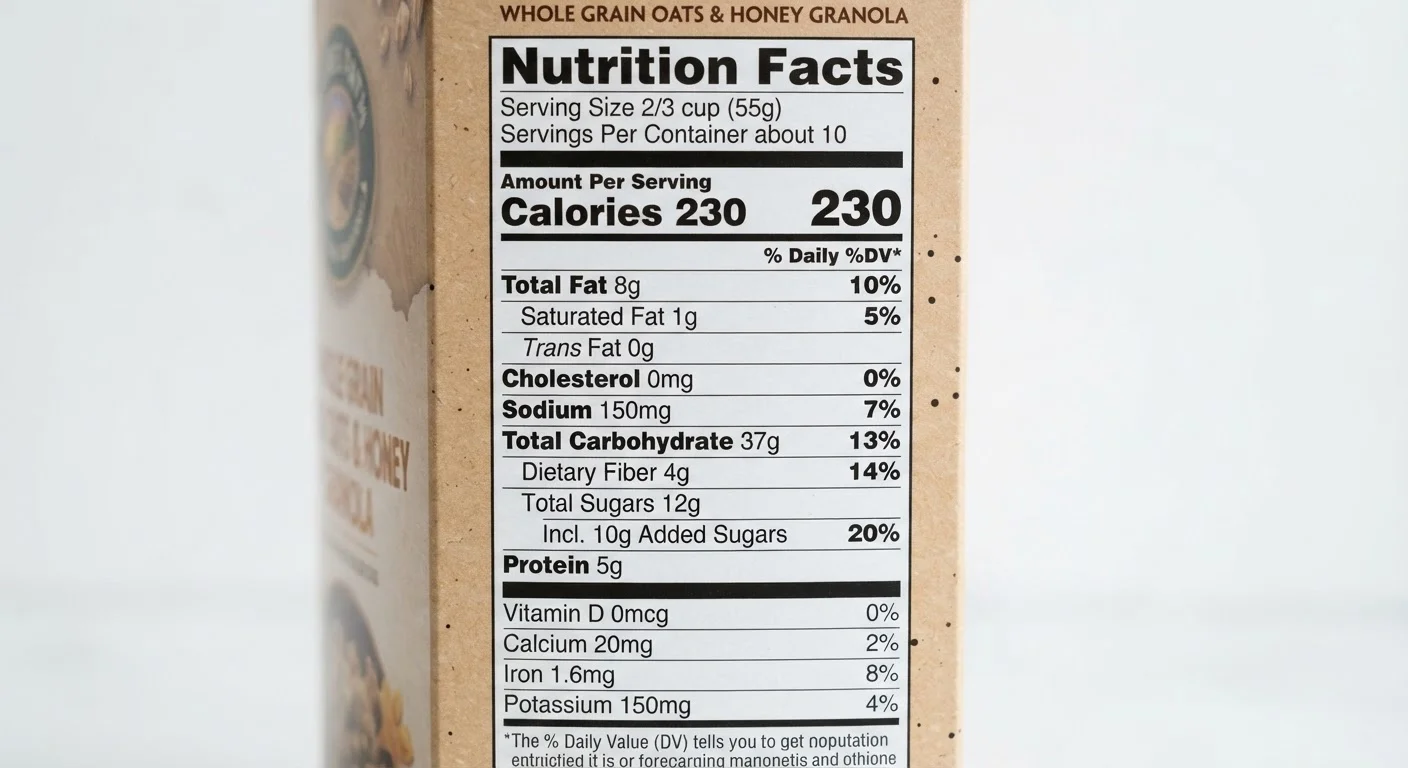
Photo: ShortwebArticles.com | Content For The Curious editorial
Start Here: Serving Size Is the Foundation
Every figure on a Nutrition Facts panel — calories, fat, sodium, sugar — applies to one serving, not necessarily the whole package. Yet research consistently shows that Americans routinely underestimate how many servings they actually eat. Before reading any other number, find the serving size and servings per container at the very top of the label.
A bag of chips might list 140 calories per serving, but if the bag contains 3.5 servings and you eat the whole thing, you've consumed 490 calories. The FDA updated Nutrition Facts panel rules to require more realistic serving sizes that reflect how people actually eat — so newer labels are more honest than older ones, but the math still matters.
Practical tip: check whether the serving size matches your actual portion. If you typically pour twice what the label lists, simply double every number shown.
| Serving Size Basis | All label numbers apply per serving, not per package (U.S. FDA Nutrition Facts Label requirements) |
| % Daily Value Reference Diet | 2,000 calories per day (FDA standard reference) |
| Low %DV Threshold | 5% DV or less (FDA consumer guidance) |
| High %DV Threshold | 20% DV or more (FDA consumer guidance) |
| Sodium Daily Reference Amount | 2,300 mg (Dietary Guidelines for Americans) |
| Added Sugars Line Required Since | 2016 FDA label update (FDA Nutrition Facts label final rule) |
Calories and the % Daily Value: Two Numbers Worth Understanding
Calories measure the energy a food provides. The number itself is neutral — it only becomes meaningful relative to your overall daily intake, activity level, and health goals. No single food's calorie count should be judged in isolation.
The % Daily Value (%DV) is a quick benchmark showing how much a nutrient in one serving contributes toward a general daily reference amount (based on a 2,000-calorie diet). The FDA's shorthand: 5% DV or less is low; 20% DV or more is high. Use this as a directional signal, not a rigid target.
- Nutrients to limit: saturated fat, sodium, and added sugars. A high %DV here is a flag worth noting.
- Nutrients to prioritize: dietary fiber, vitamin D, calcium, iron, and potassium. A higher %DV works in your favor.
For a deeper look at what carbohydrates, protein, and fat actually do in your body, see our guide to macronutrients.
70%+
Americans who misread serving sizes
Studies published in nutrition journals indicate a majority of consumers underestimate portions when reading packaged food labels.
3,400 mg
Average daily sodium intake for Americans
According to the CDC, Americans consume roughly 3,400 mg of sodium per day — nearly 50% above the 2,300 mg daily reference amount.
17 tsp
Average added sugar consumed daily
U.S. dietary surveys have estimated average added sugar intake at roughly 17 teaspoons per day, well above recommended limits.
Fats, Sodium, and Sugars: Reading the Fine Print
Total fat includes several subtypes. Saturated fat appears on its own line because dietary guidance generally recommends keeping it lower; trans fat should ideally be zero (labels listing "0 g" can still contain up to 0.5 g per serving under FDA rounding rules, so scan the ingredient list for "partially hydrogenated oils" to be sure). Unsaturated fats — the kind found in nuts, seeds, and fish — are not broken out prominently but are generally considered more favorable.
Sodium is one of the most underestimated numbers on the panel. Most Americans consume far more than the 2,300 mg daily reference amount, largely from packaged and restaurant foods rather than table salt. Learn more in our article on where sodium hides in the American diet.
Total sugars vs. added sugars: Total sugars include both naturally occurring sugars (found in fruit and dairy) and sugars added during processing. The added sugars line — a required disclosure since the 2016 label update — is the number to watch, since added sugars contribute calories without additional nutrients. Our article on added sugar vs. natural sugar covers why this distinction matters nutritionally.
Fiber often gets overlooked on the label, but it's one of the most beneficial nutrients to prioritize. Most Americans fall well short of recommended fiber intake — read more in our piece on why fiber matters.
Rounding Rules Can Be Misleading
Putting It Together at the Grocery Store
You don't need to analyze every label exhaustively. A practical grocery-store habit is to focus on three checks: serving size (is it realistic?), the short list of nutrients to limit (saturated fat, sodium, added sugars), and ingredients (the shorter and more recognizable, the better). The label is a tool for comparison — use it to contrast two similar products side by side rather than chasing perfect numbers.
The Nutrition Facts panel works best as one input among many. Context matters: a food high in sodium might still fit into an otherwise low-sodium day; a food with more saturated fat might also be rich in protein and micronutrients. For guidance on assembling meals that cover your nutritional bases without obsessive tracking, see building a balanced plate. And if you're curious about how processing affects what the label actually reflects, whole foods vs. processed foods is worth a read.
This article provides general nutrition education and is not a substitute for personalized dietary advice. Consult a registered dietitian or qualified healthcare professional for guidance tailored to your health needs.
The content on this site is for informational purposes only and is not a substitute for professional advice. Always consult a qualified professional for guidance specific to your situation.