
Carrying Cash Internationally: How Much, Which Denominations, and When to Exchange

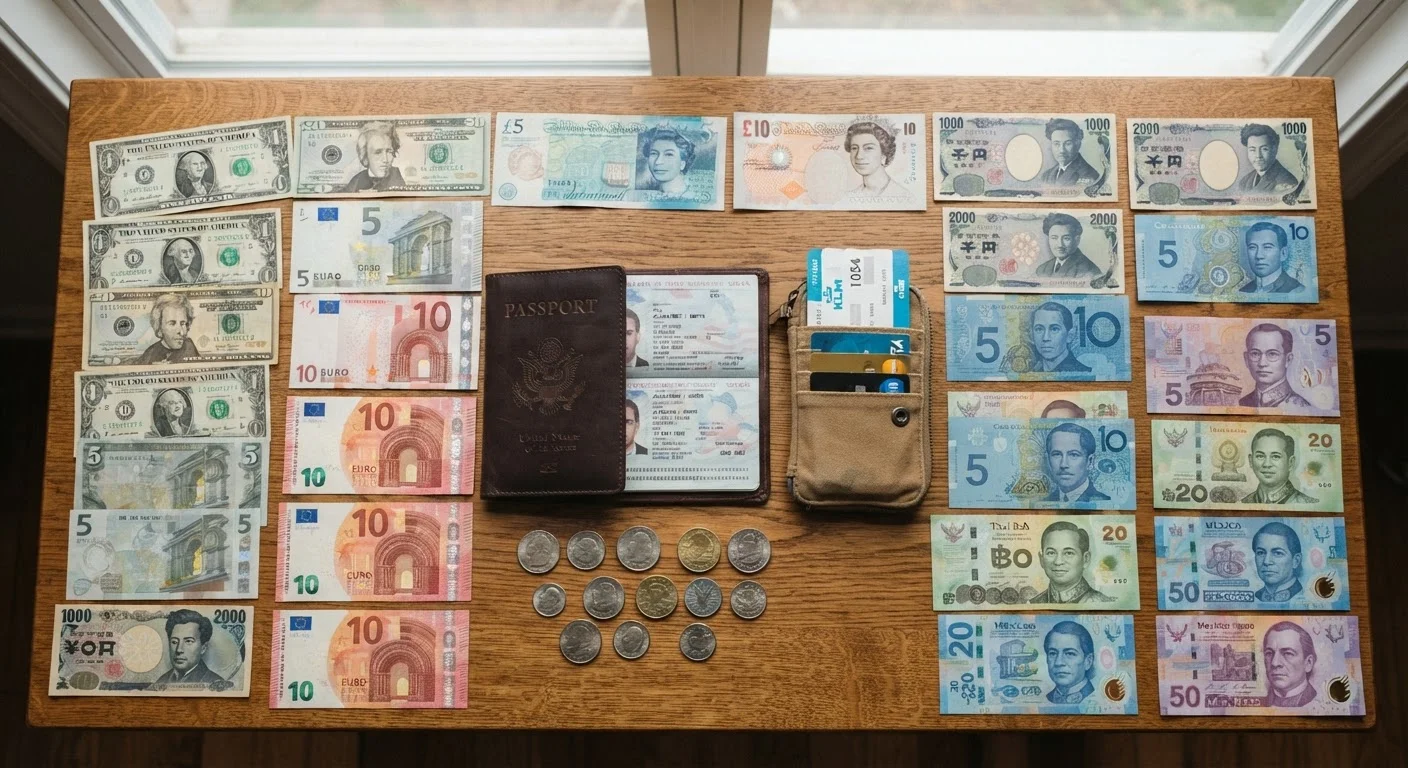
Photo: ShortwebArticles.com | Content For The Curious editorial
Key Takeaways
- Airport currency kiosks typically offer the worst exchange rates — plan ahead instead.
- Small-denomination bills are more practical than large ones in most destinations.
- A local ATM abroad often gives better rates than exchanging cash before you leave.
- Carrying $100–$200 USD equivalent on arrival covers most immediate landing-day needs.
- Always notify your bank before traveling to prevent your card from being blocked.
Why Cash Still Matters Abroad
Even in an era of tap-to-pay everything, cash remains essential in many corners of the world. Rural markets, street food vendors, small guesthouses, tuk-tuk drivers, and public restrooms in dozens of countries simply don't accept cards — and standing at a toll booth in rural Portugal with only a Visa is not the adventure you planned. If you're preparing for your first trip abroad, this practical first-timer's guide covers many of the surprises people don't anticipate, currency confusion included.
The question isn't whether to carry cash internationally — it's how much, in what form, and how to get it without throwing money away on fees and terrible exchange rates.
Airport Kiosks Cost More Than You Think
How Much Cash to Carry
A reasonable rule of thumb: arrive with enough local currency to cover your first 24 hours without needing to scramble. That typically means the equivalent of $100–$200 USD in the destination's currency. This covers a taxi or transit fare from the airport, a meal or two, tips, and any small incidentals while you get oriented.
Beyond day one, how much cash you carry depends heavily on your destination. In highly card-friendly countries — much of Western Europe, Japan, Singapore, Australia — you may rarely need more than a small amount on hand. In cash-dominant economies common across parts of Southeast Asia, Central America, and sub-Saharan Africa, you'll want to budget a larger cash float and replenish it strategically at in-network ATMs.
Think in Daily Spending Buckets
Avoid carrying your entire trip budget in cash at once. Split it between a secure travel wallet, a hotel safe, and a backup stash in your luggage — never all in one pocket.
Which Denominations to Request
When you exchange money or withdraw from an ATM, think small. Large bills create real friction abroad: a $50 or $100 equivalent note is hard to break at a local café or market stall, and vendors may refuse them outright or claim they have no change (a common workaround to avoid making change). Aim for a mix weighted toward smaller denominations — in most destinations, the equivalent of $1–$10 USD covers the majority of daily transactions.
It's also worth understanding that some U.S. dollars are universally accepted alongside local currency in certain regions — parts of Latin America, Southeast Asia, and the Caribbean in particular. In those destinations, carrying crisp, newer $1 and $5 bills as backup can be genuinely useful. Avoid worn or torn bills; some destinations reject them.
When and Where to Exchange
Here's the hierarchy from generally better to generally worse:
- Local ATMs at your destination — typically offer rates close to the interbank rate. Use ATMs affiliated with major banks, and always choose to be charged in the local currency, not USD, when the machine asks. That prompt — called dynamic currency conversion — is a trap. Our companion piece on debit card costs abroad explains exactly how that conversion quietly costs you.
- Your home bank or credit union before departure — many offer currency ordering services with reasonable rates, especially for common currencies. Allow several business days.
- Currency exchange offices in the destination city — rates vary widely; compare a few before committing, and confirm whether advertised rates apply to buying or selling.
- Airport kiosks and hotel desks — convenient, but almost always the most expensive option. Use them only for a small emergency amount if you truly have no other option.
Never Exchange Money in Unofficial Settings
Step-by-Step: Getting Your Cash Ready
Follow these steps before and during your trip to handle cash confidently and cost-effectively.
Research your destination's cash culture
Before anything else, look up whether your specific destination is card-friendly or cash-heavy. City centers in developed countries may be nearly cashless; rural areas and local markets almost never are. Travel forums, government tourism sites, and destination-specific travel communities are good starting points. Know before you go.
Notify your bank and review card fees
Alert your bank and credit card issuers to your travel dates and destinations before you leave. Without notice, international transactions can trigger automatic fraud holds. While you're at it, check each card's foreign transaction fee — even a 3% fee adds up quickly across a two-week trip.
Order or obtain a modest amount before departure
Order a small amount of local currency from your bank in advance — enough for landing-day essentials. Focus on smaller denominations. If your bank doesn't offer the currency you need, a low-fee ATM at your destination on arrival is often just as good for the first withdrawal.
Locate ATMs at or near your arrival airport
Before you fly, identify the bank-affiliated ATMs inside or just outside your arrival airport — not the independent kiosks, which charge steep fees. Knowing exactly where to go when you land removes a major stressor from your first hour in a new country.
Withdraw in local currency and decline DCC
When you use a foreign ATM, always select the option to be charged in the local currency, not in U.S. dollars. The 'pay in USD' option — dynamic currency conversion — passes control of the exchange rate to the ATM operator, almost always at a steep markup. Your home bank's rate will be more favorable.
Divide and secure your cash
Never carry all your cash in one place. Distribute it between a daily-use wallet, a secure interior pocket or money belt for your main stash, and a small backup left in your accommodation safe. This way, a pickpocket or lost bag doesn't end your trip.
For a broader look at navigating international airports once you land — including where to find ATMs on arrival — see our guide on navigating a foreign airport.
This article is for general informational purposes only and does not constitute financial or legal advice. Exchange rates, ATM availability, and local cash customs vary by destination and change over time. Always verify current conditions through official government and financial institution sources before traveling.
The content on this site is for informational purposes only and is not a substitute for professional advice. Always consult a qualified professional for guidance specific to your situation.