
Tailgating Is More Dangerous Than Most Drivers Realize

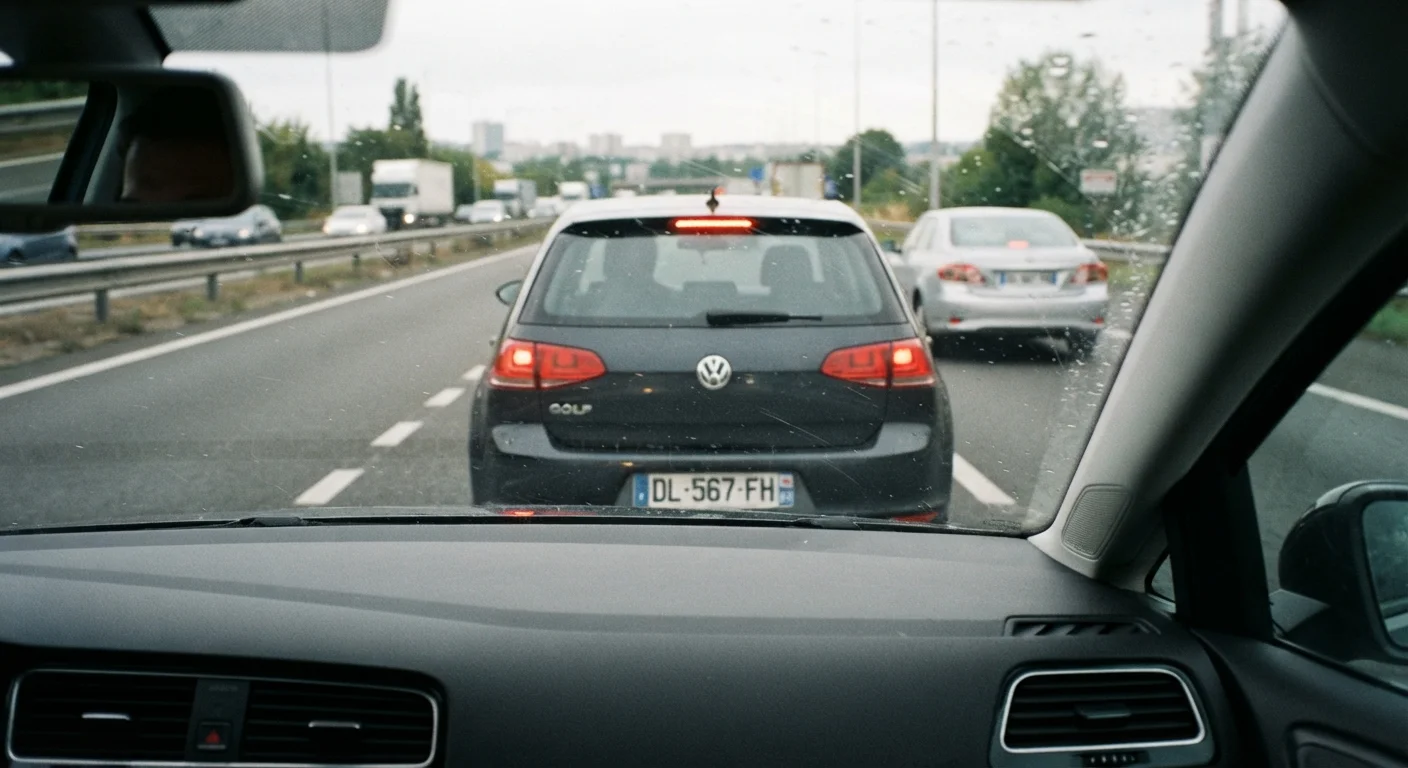
Photo: ShortwebArticles.com | Content For The Curious editorial
Key Takeaways
- Rear-end collisions are among the most common crash types in the U.S., and tailgating is a primary factor.
- Human reaction time alone typically takes over a second before any braking begins.
- The three-second rule gives drivers a practical, speed-independent way to gauge safe following distance.
- Wet or icy roads can double or triple the stopping distance your vehicle needs.
- Tailgating behind large trucks is especially dangerous because forward visibility is severely reduced.
Why Following Distance Is a Safety Margin, Not a Courtesy
Most drivers think of the gap between their car and the one ahead as empty space — wasted room another car might fill. In reality, that space is doing critical work. It's the distance your vehicle needs to stop before a collision occurs.
The problem is that human beings are poor judges of stopping distance at speed. At 65 mph, your car is covering roughly 95 feet per second. Before your foot even reaches the brake pedal, your brain has to recognize a hazard, decide to act, and transmit that signal through your body. Research on driver response times consistently places average perception-reaction time around 1.5 seconds — meaning you've already traveled more than 140 feet before braking begins.
Add the vehicle's actual braking distance on top of that, and the numbers get sobering fast. Tailgating compresses this safety margin to the point where a collision becomes nearly unavoidable once the driver ahead brakes hard.
~29%
Share of U.S. crashes that are rear-end collisions
Rear-end crashes are consistently among the most frequent crash types reported by the National Highway Traffic Safety Administration (NHTSA).
1.5 sec
Average driver perception-reaction time
Transportation research commonly cites 1.5 seconds as the average time from hazard recognition to brake application under normal conditions.
300+ ft
Total stopping distance at 60 mph
At 60 mph on dry pavement, total stopping distance including reaction time typically exceeds 300 feet for a standard passenger vehicle.
The Three-Second Rule Explained
Speed-based rules like 'one car length per 10 mph' are hard to apply in real traffic. The three-second rule is simpler and scales automatically with your speed.
Here's how it works: watch the vehicle ahead pass a fixed roadside point — a sign, a shadow line, a bridge — and start counting. If you reach that same point before you count to three, you're too close. This method works at 30 mph and at 70 mph because it measures time, not feet, and time is what your reaction system needs.
In rain, fog, snow, or on gravel, extend the count to four or five seconds. Traction is reduced, stopping distances grow, and visibility narrows — all conditions that demand more buffer, not less.
Practice the Three-Second Count on Your Next Drive
When Tailgating Becomes Even More Dangerous
Following too closely behind any vehicle is risky. But certain situations amplify the danger considerably.
- Large trucks and SUVs: Tailgating a semi-truck or large SUV cuts off your view of the road ahead entirely. You can't see brake lights, debris, or stopped traffic until it's too late to react. This is sometimes called 'no-zone' driving near commercial vehicles.
- High speeds: Stopping distances grow with the square of your speed. Going from 40 mph to 70 mph doesn't increase your stopping distance by 75% — it roughly triples it.
- Distracted driving: Even a brief glance at your phone adds a second or more to your reaction time. If you're already tailgating, that cognitive gap closes whatever margin you had. See more on how distraction compounds risk in our article on why drivers underestimate distraction.
- Night driving: Reduced visibility means hazards appear in your headlight range with less warning time. Combined with tailgating, the result is a narrow, unforgiving window. Learn more about managing after-dark risk in our guide to night driving habits that reduce risk.
Tailgating in Context: City vs. Highway
Following distance requirements don't disappear in stop-and-go city traffic — they just look different. At low speeds, a shorter physical gap is acceptable, but the principle remains: leave enough space to stop without hitting the car ahead if they brake suddenly.
At highway speeds, the stakes are simply higher. A rear-end crash at 65 mph transfers enormous energy compared to a low-speed fender bender. The consequences — vehicle damage, injury, and in serious cases, chain-reaction pile-ups — scale with speed.
Understanding how your driving approach needs to shift between environments is part of being a complete driver. Our comparison of city driving vs. highway driving goes deeper on this topic.
Maintaining appropriate following distance is also a core element of defensive driving — the broader practice of anticipating hazards rather than reacting to them. For a fuller picture, see our guide to what defensive driving actually means.
Frequently Asked Questions
The content on this site is for informational purposes only and is not a substitute for professional advice. Always consult a qualified professional for guidance specific to your situation.