
Roundabout Rules Made Simple for American Drivers

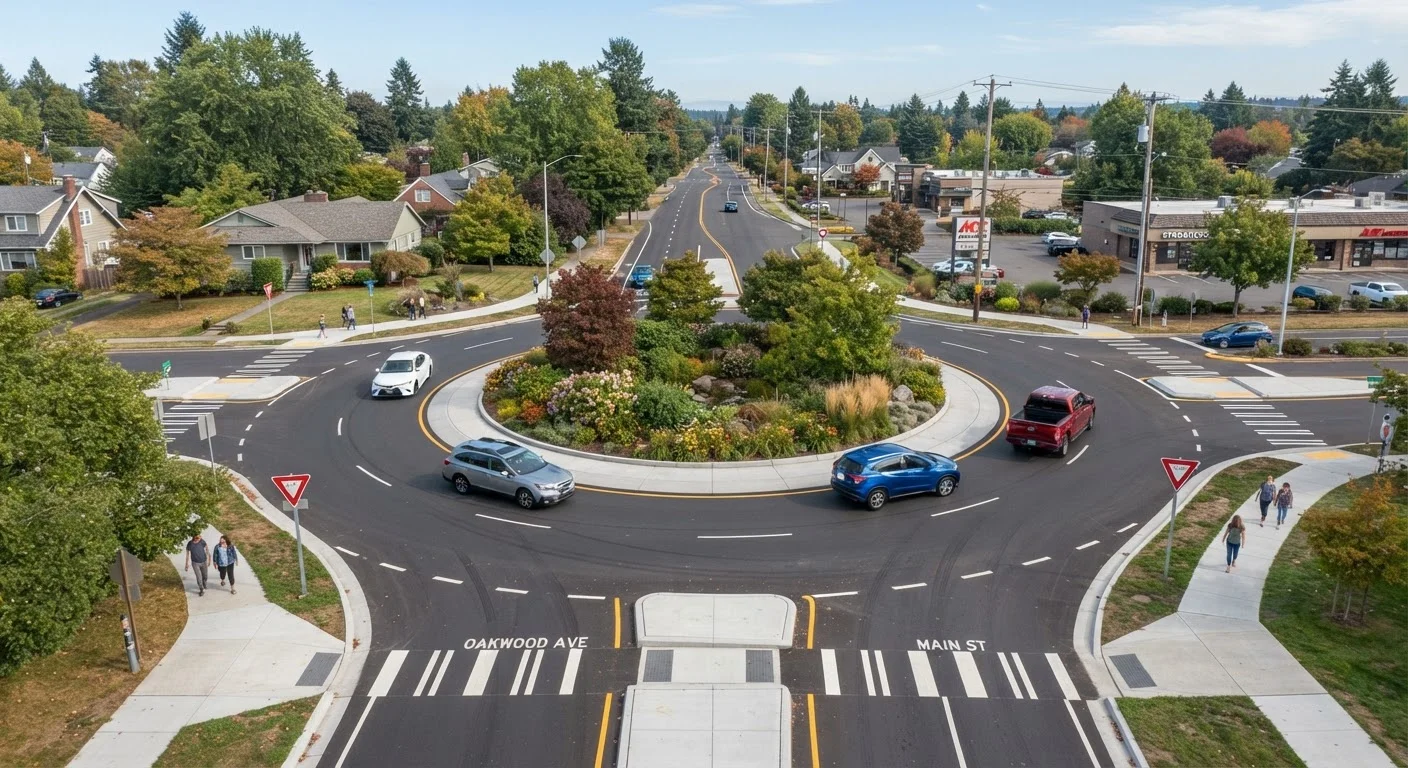
Photo: ShortwebArticles.com | Content For The Curious editorial
Key Takeaways
- Vehicles already circulating inside a roundabout always have the right of way.
- You enter only when there is a safe gap — never stop inside the roundabout unless traffic forces you to.
- Signal your exit intent before leaving so other drivers and pedestrians can anticipate your move.
- In a multi-lane roundabout, choose your lane before entering and hold it through the circle.
- Roundabouts generally reduce severe-injury crashes compared to traditional signalized intersections.
What Is a Roundabout?
A roundabout is a circular intersection where traffic flows in one direction — counterclockwise in the U.S. — around a raised central island. Unlike a traditional intersection controlled by traffic lights or stop signs, a roundabout uses continuous yielding to keep vehicles moving rather than stopping them on a fixed cycle.
The design originated in the United Kingdom and has been expanding steadily across American roads since the 1990s. You'll now encounter them in suburban neighborhoods, highway interchanges, and busy commercial corridors. Many drivers find them confusing on first encounter, but the underlying logic is straightforward once you know the one rule that governs everything inside the circle.
Understanding roundabouts fits squarely into the broader skill of navigating intersections confidently. Our guide on driving through intersections safely covers the scanning and anticipation habits that apply here too.
Yield
To give the right of way to another driver or pedestrian, letting them proceed before you enter or cross their path.
Circulating traffic
Vehicles that are already inside the roundabout and moving around the central island. They always have priority over vehicles waiting to enter.
Central island
The raised or landscaped area in the middle of a roundabout. It is not a driving surface — all vehicles travel around it, never over it.
Yield line
The painted or marked line at a roundabout entry where drivers must stop or give way before entering the circle.
Entry lane
The lane on the approach road that feeds into the roundabout. In multi-lane roundabouts, each entry lane corresponds to specific exits.
The Core Rule: Yield to Traffic Already Inside
Every roundabout interaction comes down to one principle: yield to circulating traffic. Before you enter the circle, you must give way to any vehicle already traveling within it. There are no traffic lights negotiating priority for you — it's your responsibility to find a safe gap.
At the entry point, slow down as you approach, look left (that's where circulating traffic comes from), and wait until the roadway is clear enough to merge smoothly. You do not need a massive gap — just enough space to enter at a speed that matches the flow.
Treat It Like a Merge, Not a Stop
This is a meaningful departure from the four-way stop, where arrival order determines right of way. If the distinction trips you up, our breakdown of four-way stop rules walks through how those differ from roundabout logic.
How to Enter, Navigate, and Exit
Follow this sequence every time you approach a single-lane roundabout:
- Slow down — reduce speed well before the yield line. Posted approach speeds are typically 15–25 mph.
- Look left — check for vehicles already in the circle. Pedestrian crosswalks are on the approach road; yield to anyone crossing before you enter.
- Enter on a gap — merge into the circle only when traffic allows. You must come to a complete stop if no gap exists, but do not creep into the path of circulating vehicles.
- Stay in the circle — travel counterclockwise, staying in your lane. Avoid braking hard or stopping inside unless forced to by an emergency.
- Signal and exit — as your exit approaches, activate your right turn signal to alert pedestrians and other drivers, then leave the roundabout on the designated exit lane.
If you miss your exit, keep going around. One more loop is safer than any attempt to reverse or cut across the island.
Never Reverse Inside a Roundabout
Multi-Lane Roundabouts: Choosing the Right Lane
Larger roundabouts — common on busier roads — have two or more lanes on both the approach and inside the circle. The lane you choose before entering determines which exits you can safely use.
A general guide:
- Right lane: use when turning right or going straight through to the first or second exit.
- Left lane: use when continuing straight past the midpoint, turning left, or making a U-turn back toward where you came from.
Approach signage and pavement markings tell you which lanes serve which exits — check those before committing. Once inside, hold your lane. Do not change lanes within the circle; that is a leading cause of roundabout collisions. This is similar to the discipline of holding your position during a highway merge — act decisively and don't drift.
Road markings play a big role in guiding lane selection. If you want a refresher on what pavement markings mean, our article on road lines and markings is a good companion read.
Common Mistakes — and How to Avoid Them
Even experienced drivers slip up at roundabouts. Here are the errors that come up most often:
- Stopping inside the circle
- Unnecessary stops block circulating traffic and can trigger rear-end crashes behind you. Keep moving unless a true hazard forces you to stop.
- Failing to yield on entry
- Pulling into the circle without checking for circulating traffic is the most dangerous roundabout mistake. Always look left before committing to entry.
- Ignoring pedestrian crossings
- Crosswalks sit just outside the circle on every approach and exit leg. Pedestrians cross independently of the main traffic flow, so check both before entering and after exiting.
- Not signaling the exit
- Signaling before you leave lets cyclists, pedestrians, and waiting drivers react appropriately. It takes one second and prevents real confusion.
- Choosing the wrong lane in advance
- In multi-lane roundabouts, reading the approach signs late forces last-minute weaving. Slow down early, read the signs, and commit to the correct lane before the yield line.
New drivers encounter roundabouts as one of several intersection types that cause early errors. Our article on situations where new drivers make costly errors puts this in broader context.
Roundabout Safety Research
Frequently Asked Questions
The content on this site is for informational purposes only and is not a substitute for professional advice. Always consult a qualified professional for guidance specific to your situation.